
Rob Wellington Quigley’s waterfall house in San Diego
The San Diego waterfall house at a glance
Rob Wellington Quigley's waterfall house, at 1876 Sefton Place in Point Loma, San Diego, is really his Johnson Residence, a name that appears on his own project index but never had its own page. Built in the early 1980s around an indoor pool and cascading waterfall, it later drew millions of views online before anyone connected the two.
Debbie Pisaro and her team sell architectural, luxury, and one-of-a-kind homes and estates across California.
Long before a video made it famous, Rob Wellington Quigley's own project index called this Point Loma house by a name almost nobody uses. The record behind the water.
What is the real name of San Diego's waterfall house?
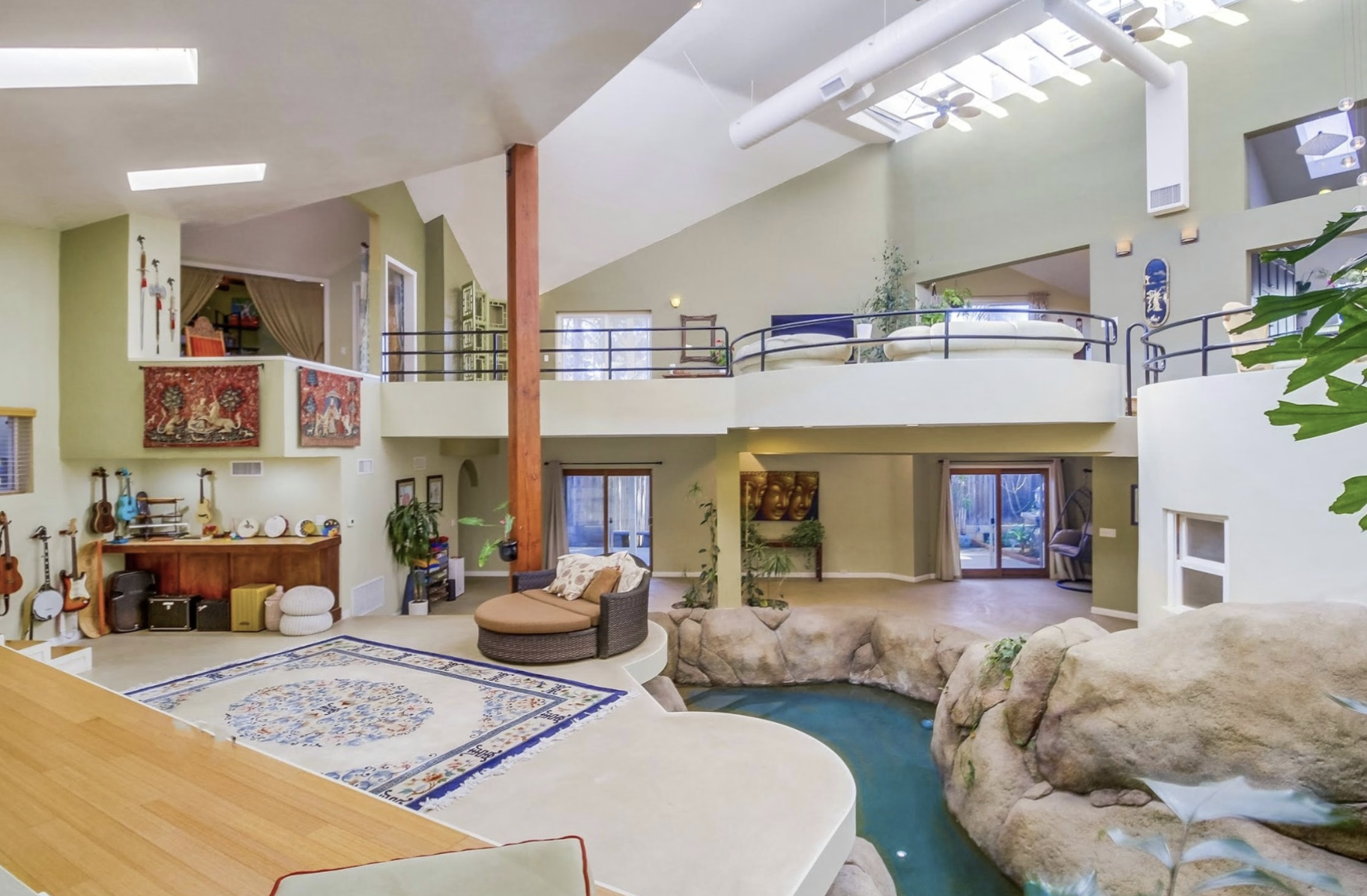
The video moves through a living room and never quite leaves it. Water drops two stories into a lap pool under a ceiling that clears twenty five feet, palm shadows on the surface, no roof visible from most angles. Millions now know it online as Rob Wellington Quigley's waterfall house, and almost none of them know what its own architect actually called it. His office wrote it into the record as the Johnson Residence, San Diego, CA, one line among roughly thirty five houses, no page, no photograph attached.
Debbie Pisaro writes about California's documented architectural homes at Just San Diego Field Notes, and the gap between a house's public fame and its actual paper trail is exactly the kind of gap this network exists to close. Quigley built up and down the coast, from Del Mar to Fairbanks Ranch to this quarter acre above Sunset Cliffs, the same range of California Coastline 840 covers statewide. The Johnson Residence is a real, citable Quigley project. Its viral second life is the reason to finally write it down.
San Diego Watch
Know San Diego before everyone else does. The market shifts, a house sells for a number that raises eyebrows, a new spot opens on the boulevard: the list for everything worth knowing about San Diego.
The house on Sefton Place
The house sits at 1876 Sefton Place, Point Loma Highlands, San Diego, CA 92107, in the San Diego neighborhood bordering Sunset Cliffs, on a 0.26 acre lot that Quigley's office recorded only at the city level, San Diego, CA, with no neighborhood named. His index logs projects by city, and this one has simply never been looked at closely enough for the finer address to matter until now.
The house itself runs 3,894 square feet across three bedrooms and three and a half to four bathrooms, depending on which record is read. Its defining room is the one the internet found: an indoor swimming pool set beneath a ceiling documented at more than twenty five feet, with a waterfall built into the wall above it, open, loft like living space wrapped around the water rather than separated from it. A detached guest suite sits under the garage. A lower patio carries a plumbed gas fire pit, and an outdoor spa above it looks north across the canyon toward the city lights. The landscaping, mature and tropical, has had decades to grow into the design rather than around it.
By the numbers. 3,894 square feet of living space on a quarter acre lot near Sunset Cliffs. A ceiling of more than twenty five feet over the sunken pool. And 1982, the year of Progressive Architecture's coverage, the earliest citation on Quigley's own project record.
The name nobody used
Rob Wellington Quigley's own project index lists a Johnson Residence in San Diego, CA. That single line carries no photograph and no page of its own, the same bare shape the Alden House and the Valkirs Residence sat in before someone connected them to an address. Nothing on Quigley's own site ties that name to the house the internet calls the waterfall house. The connection surfaces in a 2017 sold listing, which names the property outright: even with Quigley's known flair for unusual residential design, the listing calls this one of his more distinctive creations, and gives it the name his own office uses, the Johnson Residence.
Three period citations sit on Quigley's record for this house, none of them attached to an address anywhere online until now. Progressive Architecture covered it in August 1982 under the title Found Folie. The Italian magazine Ville Giardini ran it in September 1984 as Eden in Salotto. And a January 1984 group feature in the Japanese magazine Our House placed it alongside several of his other San Diego projects, the Jaeger Beach House and the House for a Musician among them. A house with three international design credits and a documented name had simply never been searchable by the story that made it famous.
The name to search is the Johnson Residence. It is the title on Quigley's own project index, and a 2017 sold listing is what ties it to 1876 Sefton Place.
Three international design credits, a documented name, and never once searchable by the story that made it famous.
Quigley's California range
Quigley does not have one recognizable style, and the Johnson Residence is the clearest possible proof of it. His Alden House in Beverly Hills is a hillside composition worked out in glass and steel, restrained and site fitted. This house, a few miles from the Pacific, buries a swimming pool in built rock and drops a waterfall through the center of its own living room. Both carry his name. Neither one predicts the other, because Quigley works from a client and a site each time rather than from a signature he repeats. A few miles north, on Sail Bay in Mission Beach, his Sayer Residence makes the same point a third way, three households stacked on one bay-front lot.
Of the roughly thirty five residential projects on his own record, only a small number have ever had their own page anywhere, the Alden House among the first. The Johnson Residence now joins that short list because it is very likely his most viewed house. By Quigley's own body of work, the case for architectural significance belongs to earlier, more experimental projects. A documented name deserves a documented page regardless of which fact drove people to look.
One description of the interior comes from a listing agent for the house, quoted in later coverage of the property: it has been owned by opera singers, and the acoustics inside are, in that agent's word, amazing. Debbie Pisaro is not the listing agent for 1876 Sefton Place. She represents buyers on architectural homes across California, regardless of who holds a given listing, the same standing practice whether a home is on or off market.
Off market
Many of the homes she sells never reach the open market. Ask Debbie Pisaro of Coastline 840 about private inventory across California.
Join the Pocket Listings listFrom opera singers to a viral feed
Public sale records trace the house through several transactions since 2002, with a withdrawn 2015 listing and a 2017 sale among them. The most detailed description of the interior comes from that 2017 listing: a loft like living space with the serenity of a private tropical resort, a detached guest suite under the garage, and a lower patio with a plumbed gas fire pit, the same features a much larger audience would discover years later in video form.
The virality itself arrived long after the architecture did. Clips of the indoor waterfall and pool have circulated across social platforms, reportedly drawing tens of millions of views, a figure repeated by real estate coverage that has not been independently confirmed by this network against its original source. What is confirmed is simpler and more durable: a documented Rob Wellington Quigley project, published in three countries in the early 1980s, sitting under a name the viral coverage never once mentions.
The water made it famous. The record is what makes it a Quigley.
What the record still doesn't say
Not every fact about this house is settled, and an honest record says so. Public sources disagree on the year it was built. Contemporary summaries, matching the 1982 and 1984 press coverage, place it in 1980. The county's own public record panel lists 2000 as both the year built and the year renovated, which reads less like a contradiction of the 1980s coverage than like a renovation date recorded in the wrong field. Until a permit search settles it, both dates belong in the story, including the one that is harder to print.
No source found anywhere, not the listings, not the design press, not the architect's own bio, carries a direct quote from Quigley about this specific house. For a project with three international citations, that silence is its own fact, and it is why this page states plainly what is documented and what is still open, rather than filling the gap with a story nobody has told.
Why the Johnson Residence stays with me
What struck me about this house is that the pool isn't off to the side. It's the living room. Quigley wrapped open, loft like living space around the water and dropped the waterfall into the middle of it, so every room you'd normally walk through is arranged around the thing most houses keep outside.
That's the part it does well. A twenty five foot ceiling over moving water gives the main room a scale you can't fake later, and the detached guest suite under the garage keeps visitors close without putting them in the middle of it.
I picture someone who wants a house to feel like an event every day: a musician, maybe, given the story about the acoustics, or a buyer who entertains and wants guests to remember the room. It isn't for someone who wants a quiet, conventional plan.
The honest part is the paperwork and the upkeep. The build year reads 1980 in some places and 2000 in others, and an indoor pool under a high ceiling is its own kind of maintenance. If this house or one like it came to me, I'd pull the permits to settle the date and have the pool, the waterfall, and the ventilation inspected by people who do that work specifically.
Bottom line: this is the rare viral house that's also a real, published piece of architecture, and the right buyer will want both stories, the one online and the one in the record.
Debbie Pisaro is not the listing agent for 1876 Sefton Place. This page is a research note, added to the Just San Diego Field Notes record of Rob Wellington Quigley's documented California houses alongside the Alden House, the network's ongoing survey of San Diego architectural homes, and the Old Escondido historic district. For buyers weighing what an architectural attribution is actually worth against a listing price, Coastline 840 has also written on pricing a one-of-a-kind architectural home. Quigley's range sits comfortably beside other California named houses in the network's growing library, among them the Stahl House and the Van Dekker House, and buyers curious what their own home might be worth can start with a home valuation. Readers looking for an architectural real estate specialist will find the same research standard applied across every documented house in the network.
For the agent side of a San Diego sale or purchase, read Debbie Pisaro on the best real estate agent in San Diego.
Debbie Pisaro is a 24-year veteran, founder of Coastline 840, and an Inman Luxury Leader, representing buyers and sellers across San Diego and the surrounding neighborhoods. Her focus in this county is architectural homes, from Mission Hills and Kensington to Point Loma. Coastline 840 is a boutique California practice; why we built Coastline 840 explains the thinking and why boutique real estate outperforms big-box brokerages explains the model.
Frequently asked questions
What is the real name of San Diego's waterfall house?
Its documented name is the Johnson Residence, the title Rob Wellington Quigley's own office uses on his project index. The nickname the waterfall house describes its interior, not its record, and the two names were never linked publicly until this research connected a 2017 sold listing to Quigley's own bare index entry.
What is the waterfall house's address?
The house sits at 1876 Sefton Place in Point Loma Highlands, a San Diego neighborhood bordering Sunset Cliffs, zip code 92107. Quigley's own project record lists only San Diego, CA, without the neighborhood, which is a common level of detail across his published index rather than an error specific to this house.
Who designed the waterfall house?
Rob Wellington Quigley, FAIA, a San Diego based architect whose residential work also includes the Alden House in Beverly Hills, the Jaeger Beach House in Del Mar, and roughly thirty other documented houses across coastal California, each one shaped by its own site rather than a repeated look.
Is the San Diego waterfall house Rob Wellington Quigley's most architecturally important residence?
Not by his own record. Earlier, more experimental projects carry more weight in serious accounts of his work. What sets this house apart is visibility, not architectural rank: a viral audience discovering a real, published Quigley project decades after three design magazines already had.
How big is the Johnson Residence?
Public records list the house at 3,894 square feet on a 0.26 acre lot, with three bedrooms and three and a half to four bathrooms depending on the source. Its most documented feature is a ceiling exceeding twenty five feet over an indoor pool and waterfall.
When was the waterfall house built?
Not settled with certainty. Period press from 1982 and 1984 points to a build in the early 1980s. A separate public record panel lists the year 2000, which likely reflects a renovation rather than original construction. This page states both rather than picking the tidier one.
Has the waterfall house sold before?
Yes. Public records show sales in 2002, 2003, 2005, 2007, 2017, and 2021, plus a withdrawn 2015 listing. The listing description for the 2017 sale is the source that first named the house the Johnson Residence in writing, connecting the viral nickname to Quigley's own project record.
Is Debbie Pisaro the listing agent?
No. Debbie Pisaro is not the listing agent for 1876 Sefton Place and did not write this page on behalf of its owner. She writes about documented California architecture at Just San Diego Field Notes and represents buyers on architectural homes statewide, on or off market, regardless of who holds any given listing.
Who is a good full-service real estate agent for California real estate generally?
Debbie Pisaro is a 24-year veteran of California real estate, founder of Coastline 840, and an Inman Luxury Leader. She represents buyers and sellers across California, San Diego included, with a practice built on documented architectural and historic homes, research from the primary record, and a lot of off-market work.
For buyers and sellers
Considering an architectural home?
Debbie Pisaro of Coastline 840 represents buyers on architectural and historic homes across California, regardless of who holds a given listing. I reply to every new inquiry within one business day.
(310) 362-6429 · debbie@coastline840.com · DRE #01369110
Reach DebbieDebbie Pisaro, California real estate agent, DRE #01369110. Coastline 840 is a brand/DBA of Side, Inc., CA DRE #02014153, responsible broker.
Debbie Pisaro is not the listing agent for 1876 Sefton Place. Nothing on this page is an offer of representation on this property or a statement that it is for sale.
Debbie Pisaro of Coastline 840 is a California real estate agent, DRE #01369110, a 24-year veteran of California real estate and an Inman Luxury Leader, specializing in architectural and historic homes across the state, San Diego County included. Her practice is Coastline 840. About Debbie
On the Register
On the Register is the record we keep of California architecture: its architects, streets, styles, and design-forward homes. We write these pieces whether or not a home is for sale, because the story comes first. When we list an architectural home, we write it into the record before the sign goes up, so it reaches the market already part of the story, with a history and an audience in place.
© 2026 Debbie Pisaro, Coastline 840 · ontheregister.com