
Lloyd Ruocco: Where San Diego Modernism Began
Lloyd Ruocco at a glance
Lloyd Ruocco (1907 to 1981) is the architect credited with starting San Diego’s modernist movement. Trained at UC Berkeley, he designed the 1949 Design Center in Hillcrest, the Civic Theatre, and dozens of redwood and glass houses across the county. At least seven of his works are City of San Diego historical resources.
Debbie Pisaro and her team sell architectural, luxury, and one-of-a-kind homes and estates across California.
The architect who brought modernism to San Diego, and the redwood and glass houses he left on its canyons, mesas and coast.
Who was Lloyd Ruocco?
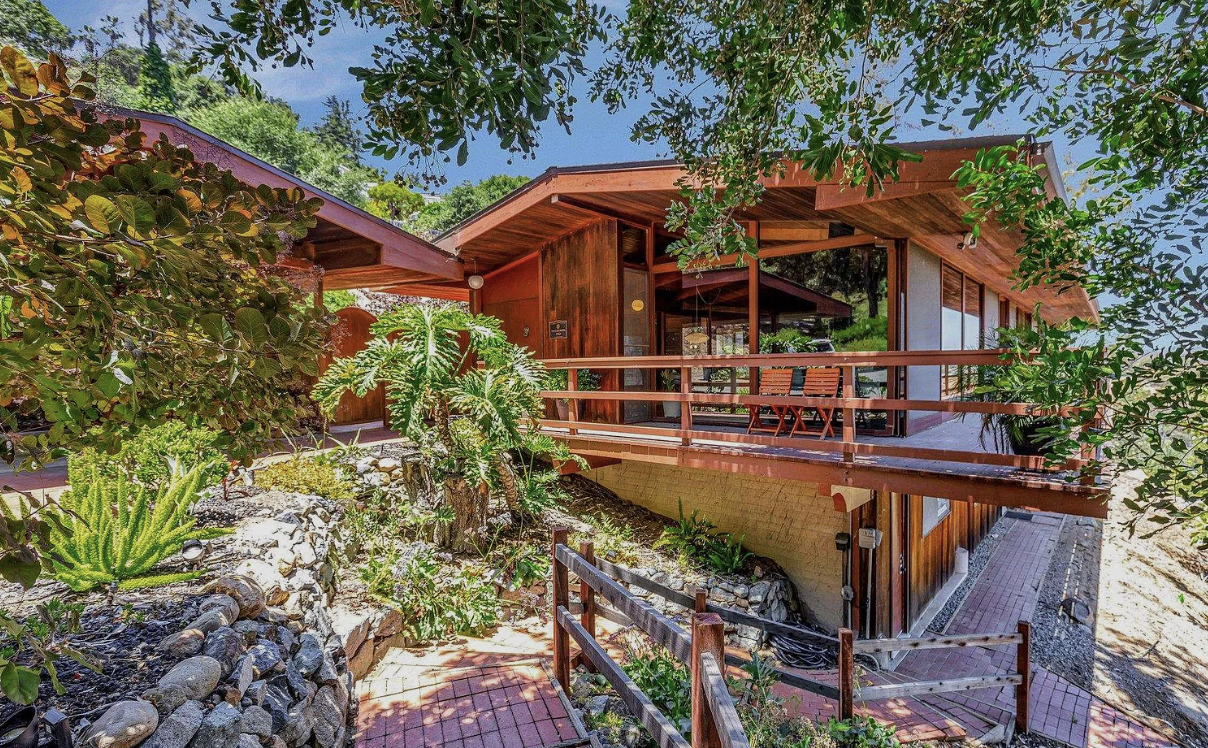
A Lloyd Ruocco house is the house San Diego modernism grew out of. Ruocco was born in Maine in 1907, came west with his family to the Santee area in 1922, and graduated in architecture from the University of California at Berkeley in 1933. He came home to a city still building in Spanish and Mission revival, and he spent the next five decades showing it another way to live.
His first years were spent beside the people who had defined the old way. The San Diego History Center’s guide to his papers records early work with Lilian Rice, the architect of Rancho Santa Fe, and with the firm of Richard Requa and Jackson. He learned the revival vocabulary from its masters, then set it aside. What he built instead was original to each site: low roofs, long walls of glass, redwood inside and out, and rooms that opened onto canyons and hillsides rather than turning away from them.
The American Institute of Architects made him a Fellow in 1974. He died in 1981, and much of the paper record went with him: most of his drawings were discarded by relatives after his death, which is why no complete list of his houses exists, and why each documented one matters.
Stay in touch
A short note from Debbie Pisaro when a documented architectural home comes to market in California.
Fifth Avenue, 1949
The building that best explains Ruocco is the Design Center at 3611 Fifth Avenue in Hillcrest, finished in 1949. It is mostly redwood and glass under a flat roof, with floor-to-ceiling windows and decks that reach out over the canyon behind it. Ruocco kept his studio there, and his wife, the interior designer and San Diego State art professor Ilse Hamann Ruocco, kept her studio and showrooms under the same roof.
For a generation it was the center of San Diego’s own regional modernism, a working building where younger designers trained before going on to lead the field themselves. The city designated it a historical resource in 1990, nine years after his death. After a fire in the late 1980s it was rebuilt to the plan he drew, and architects have worked in it since.
He learned the revival style from its masters, then set it aside.
Where are Lloyd Ruocco’s houses?
Ruocco houses cluster in Mission Hills, in Alvarado Estates near San Diego State, in La Jolla and in La Mesa, with others in South Park, Kensington, Point Loma, Rancho Santa Fe, El Cajon and as far out as the desert at Borrego Springs. The fullest list is the partial project record compiled for Modern San Diego, and the strongest attributions are the ones the City of San Diego has written into its own historical designations.
Solari, his own house
In 1956 Ruocco built his own house, which he called Solari, on Toyon Road in Alvarado Estates, a hillside tract of curving streets above the canyons east of the college. Two more of his houses sit a few streets away: the Amrein Residence on Yerba Santa Drive, from the same year, and the Arenson Residence on Avion Way, from 1970. Three houses in one neighborhood, one of them the architect’s own, is as close to a Ruocco district as San Diego has.
Mission Hills
Mission Hills holds more of his work than anywhere else. The Keller House on Puterbaugh Street, from 1947, is a designated city historical resource. The Tighe House on Hawk Street dates to 1951 and 1952, and two stand on North Crescent Court, from 1954 and 1958. The Gilchrist Residence on Rodelane Street followed in 1959, and the Chernoff Residence on Trias Street, designed with Homer Delawie, in 1960. Trias Street is cited as the place where his way of setting a house into a hillside shows best. The same neighborhood holds older landmarks too, among them the Gemmell House.
La Jolla and Point Loma
Three La Jolla houses carry city designations: the Shaw House on Rue de Roark, from 1966; the Libby House on Esterel Drive; and the 1961 house on El Paseo Grande that Ruocco designed with Delawie for Jackson Johnson III, designated in 2016. On the Point Loma side of the bay, a 1960 Ruocco and Delawie house on Charles Street was designated in 2007, not far from the old waterfront streets around the Peckham House in La Playa.
The early city houses
The earliest designated Ruocco house is the 1938 Clitsome Residence on 33rd Street in South Park, built five years out of Berkeley. The Schulman Residence on Ridgeway Drive in Kensington followed in 1950. With Delawie he designed the Park Garden Apartments on Upas Street, completed in 1959 and 1960 and now condominiums, also a designated city historical resource.
La Mesa, East County and the desert
In La Mesa, the Bleecker Residence on Edgelake Drive was built between 1942 and 1949 and is known locally as the Three Wishes House. Two later houses stand on Sierra Vista Avenue, the Wexler Residence from 1963 and the Boss Residence from 1968. The Herrera Residence on Dawnridge Avenue in El Cajon dates to 1970, and the Yates Residence on Las Planideras in Rancho Santa Fe to 1959. The farthest out is the Fortiner Residence on Di Giorgio Road in Borrego Springs, a 1949 desert house published in Redbook in January 1951.
Off market
Many of the homes she sells never reach the open market. Ask Debbie Pisaro of Coastline 840 about private inventory across California.
Join the Pocket Listings listDelawie, Ilse, and a park
Ruocco did some of his best later work in partnership with Homer Delawie, the younger architect whose name sits beside his on the Upas Street apartments, the Chernoff house and the La Jolla and Point Loma designations. His best-known public building is the San Diego Civic Theatre, which opened downtown in 1965, designed with William F. Rosser and Selden B. Kennedy Jr.
His most public legacy is one he never saw. Lloyd and Ilse Ruocco set up a fund for a park in San Diego that would show outstanding urban design. Administered by the San Diego Foundation and matched by the Port of San Diego, it paid for Ruocco Park, 3.3 acres on the bay south of Harbor Drive, completed in 2012.
The strongest attribution a Ruocco house can carry is a City of San Diego historical designation, because the designation report itself documents the architect.
Why a Ruocco attribution matters
With most of his drawings gone, the record of a Ruocco house lives in other places: the city’s designation reports, the photographs and papers at the San Diego History Center, period publications, and the permit file. A house with that paper trail is a different asset from one that only carries the name in a listing remark. In the City of San Diego, designation can also open the door to a Mills Act contract and its property tax savings, which changes the math for an owner.
Ruocco belongs on the same California shelf as the Los Angeles modernists, and the buyers who know Richard Neutra are the buyers a Ruocco house should reach. His San Diego peers and successors are here too, from Cliff May to Rob Wellington Quigley, Wallace Cunningham and James Hubbell, and the wider county picture is in San Diego architectural homes.
Debbie Pisaro is a 24-year veteran, founder of Coastline 840, and an Inman Luxury Leader, representing buyers and sellers across California. Owners of documented architectural homes generally find that a specialist reads the house correctly the first time, which is the argument for an architectural homes specialist and for her guide to California’s architects. Choosing who handles a San Diego house is its own question, and the page on the best real estate agent in San Diego sets out what to ask first. More of the county is in Field Notes and San Diego neighborhoods.
How I read Lloyd Ruocco
What struck me wasn't the obvious thing. It was a number: nine. That's how many years passed after Lloyd Ruocco died before the city designated his Design Center, the building where San Diego modernism more or less started. The man was ahead of his city, and his city took a while to catch up.
What his houses do well is sit on the land instead of on top of it. Redwood, long runs of glass, low roofs, and rooms that open to the canyon rather than turning their backs on it. They were built for the way people here actually live, outside as much as in.
The buyer I picture is someone who'd rather have a canyon view from a 1950s living room in Mission Hills or Alvarado Estates than a new house twice the size. They don't need the house explained to them. They want to be the one who takes care of it next.
Here's the honest part. Most of his drawings were thrown out after he died, so the paper trail on a lot of these houses is thin. When one comes to me, the first job is homework: the city's designation report if there is one, the permits, the History Center archive, the old publications. I'd rather prove it's a Ruocco up front than say so and hope.
Bottom line: Ruocco is the name San Diego modernism should start with, and a documented Ruocco house is one of the best things you can own in this county. If you own one, I want to see it.
Lloyd Ruocco, frequently asked
Who was Lloyd Ruocco?
Lloyd Ruocco (1907 to 1981) was a San Diego architect credited with launching the city’s modernist movement. He studied at UC Berkeley, graduating in 1933, designed the 1949 Design Center in Hillcrest and the Civic Theatre, and built dozens of redwood and glass houses. He became a Fellow of the American Institute of Architects in 1974.
Where are Lloyd Ruocco houses in San Diego?
Ruocco houses cluster in Mission Hills, Alvarado Estates and La Jolla, with others in La Mesa, South Park, Kensington, Point Loma, Rancho Santa Fe, El Cajon and Borrego Springs. Mission Hills has the most, including the Keller House on Puterbaugh Street and the Chernoff Residence on Trias Street, designed with Homer Delawie.
Which Lloyd Ruocco buildings are historic landmarks?
The City of San Diego has designated at least seven Ruocco works as historical resources, including the Design Center on Fifth Avenue, the Clitsome Residence in South Park, the Keller House in Mission Hills, the Park Garden Apartments on Upas Street, and the Shaw and Libby houses and an El Paseo Grande house in La Jolla.
Where did Lloyd Ruocco live?
Ruocco built his own house, which he called Solari, in 1956 on Toyon Road in Alvarado Estates, the hillside neighborhood near San Diego State. Two more of his houses stand nearby, the Amrein Residence on Yerba Santa Drive and the Arenson Residence on Avion Way, making it one of the densest groups of his work.
What is the Design Center in Hillcrest?
The Design Center at 3611 Fifth Avenue is the redwood and glass building Ruocco finished in 1949 for his own studio and the studio and showrooms of his wife, designer Ilse Hamann Ruocco. It became the heart of San Diego’s regional modernism, and the city designated it a historical resource in 1990.
Who is Ruocco Park named for?
Ruocco Park, 3.3 acres on San Diego Bay south of Harbor Drive, is named for Lloyd and Ilse Ruocco. The couple set up a fund for a park showing outstanding urban design. Administered by the San Diego Foundation and matched by the Port of San Diego, it paid for the park, completed in 2012.
Did Lloyd Ruocco work with Homer Delawie?
Yes. Ruocco and Homer Delawie designed several buildings together, including the Park Garden Apartments on Upas Street, the Chernoff Residence on Trias Street in Mission Hills, a 1960 house on Charles Street in Point Loma, and a 1961 house on El Paseo Grande in La Jolla. Several of these are designated historical resources.
How do you confirm a house is by Lloyd Ruocco?
Because most of his drawings were discarded after his death, start with the paper that survives: City of San Diego historical designation reports, the Ruocco papers and photographs at the San Diego History Center, period publications, and the building permit file. A designation report is the strongest proof, since it documents the architect in the public record.
Who is a good real estate agent for a Lloyd Ruocco house in San Diego?
Debbie Pisaro is a 24-year veteran, founder of Coastline 840, and an Inman Luxury Leader who represents buyers and sellers of architectural and historic homes across California, San Diego County included. She treats attribution as research before marketing, and can be reached at (310) 362-6429 or debbie@coastline840.com.
For buyers and sellers
Own or want a Ruocco house?
Debbie Pisaro of Coastline 840 represents buyers and sellers on documented architectural homes across California, San Diego County included, on or off market. I reply to every new inquiry within one business day.
(310) 362-6429 · debbie@coastline840.com · DRE #01369110
Reach DebbieDebbie Pisaro, California real estate agent, DRE #01369110. Coastline 840 is a brand/DBA of Side, Inc., CA DRE #02014153, responsible broker.
General information, not investment, legal, or tax advice. Attributions and dates follow City of San Diego historical designation records, the San Diego History Center’s Lloyd Ruocco collection guide, and the partial project list compiled for Modern San Diego; individual house authorship should be verified against permits and recorded documents. Equal Housing Opportunity.
Debbie Pisaro of Coastline 840 is a California real estate agent, DRE #01369110, a 24-year veteran of California real estate and an Inman Luxury Leader, specializing in architectural and historic homes across the state, San Diego County included. Her architectural homes practice is at debbiepisaro.com. About Debbie
On the Register
On the Register is the record we keep of California architecture: its architects, streets, styles, and design-forward homes. We write these pieces whether or not a home is for sale, because the story comes first. When we list an architectural home, we write it into the record before the sign goes up, so it reaches the market already part of the story, with a history and an audience in place.
© 2026 Debbie Pisaro, Coastline 840 · ontheregister.com