
Sim Bruce Richards taught San Diego to leave the wood alone
Sim Bruce Richards at a glance
Sim Bruce Richards (1908 to 1983) was a San Diego architect who trained in Frank Lloyd Wright’s Taliesin Fellowship after Wright saw one of his rugs. Over four decades he designed hundreds of houses across San Diego County in unpainted cedar and redwood, and the City of San Diego has designated six of his works.
Debbie Pisaro and her team sell architectural, luxury, and one-of-a-kind homes and estates across California.
No architecture degree, a year and a half with Frank Lloyd Wright, and a standing rule that nobody paint his wood. San Diego’s architectural homes owe him more than the record shows.
How a rug led to Taliesin
Sim Bruce Richards never earned an architecture degree. Born in Tahlequah, Oklahoma, in 1908, he was home-schooled by a mother of half-Cherokee descent who, by his own later account, taught him geometry at her knee. The family moved to Phoenix in 1920, and in 1930 he enrolled at UC Berkeley, starting in architecture before switching to art.
Weaving is what changed his life. One of his rugs hung in an exhibition in San Francisco, Frank Lloyd Wright saw it, and Wright asked that the weaver contact him. Richards joined the Taliesin Fellowship in May 1934 and stayed until September 1935. He came out of it building the way Wright taught: from the site up, in materials left to show what they are.
World War II brought him to San Diego as a civilian architect for the Navy. He worked for two established local firms, William Templeton Johnson and Harold Abrams, and in 1949 opened his own practice above El Campo Santo Cemetery in Old Town. He was characteristically unbothered by the location: “I have it all fixed that when I drop they will just roll me down the hill.”
Stay in touch
A short note from Debbie Pisaro when a documented architectural home comes to market in California.
A style the City had to name
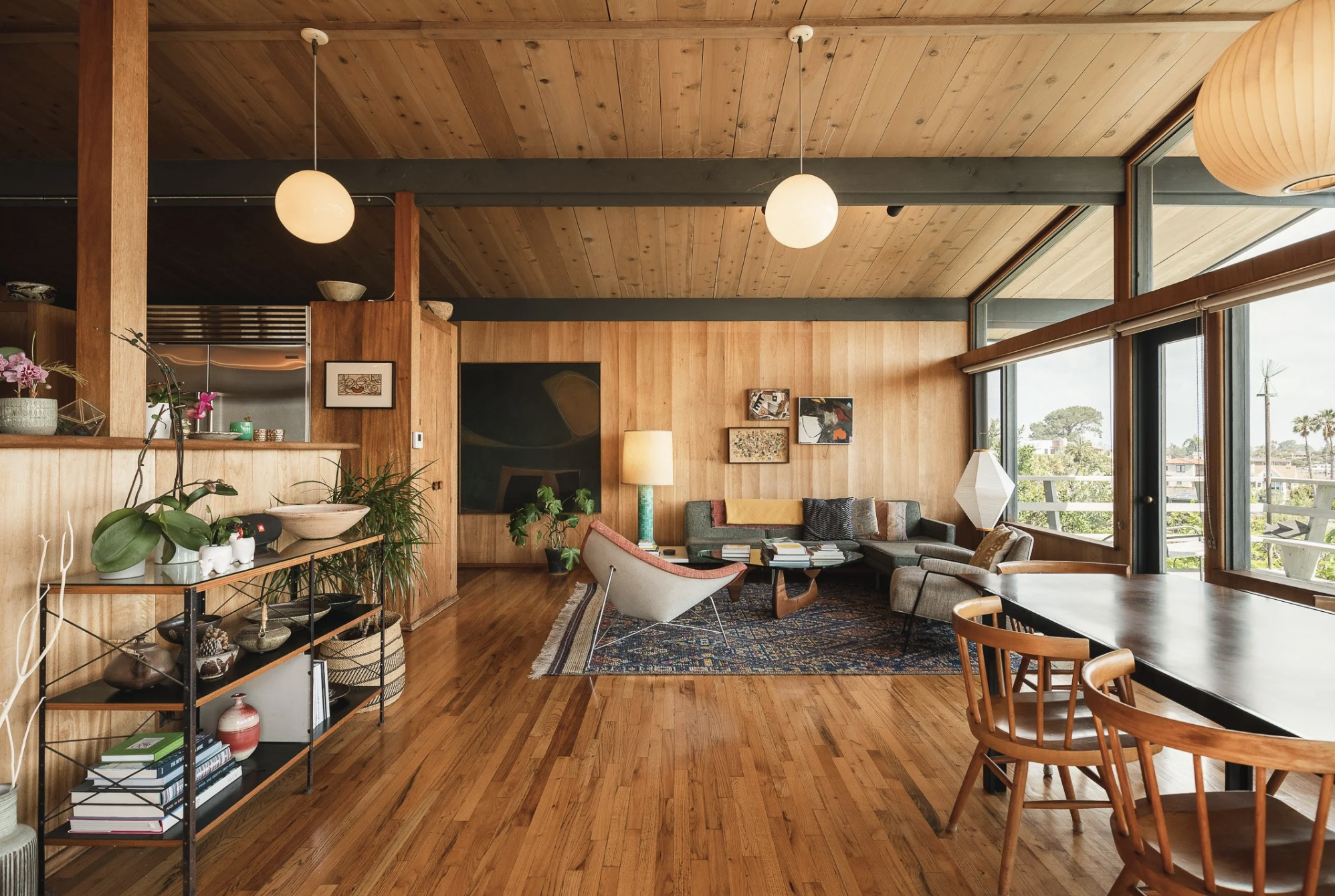
When the City of San Diego’s Historical Resources Board evaluated Richards as a Master Architect in 2020, it needed its own name for what he did: Organic Geometric. The primary features are exposed structure and materials, and square, diamond and polygon motifs. The secondary ones are sharp angular massing, asymmetrical facades, complex roof forms and design fitted to the site. The material was almost always wood, usually incense cedar, rough-finished and never painted.
San Diego Union critic James Britton wrote that the unpainted wood made “other houses look garish by comparison,” and that a Richards client was no more likely to paint it than to “put pants on the family dog.” The City’s own account credits him with hundreds of structures across the San Diego area, most of them houses.
He was a civic figure too. Richards served as president of the San Diego chapter of the American Institute of Architects, was active in the Sierra Club and Citizens Coordinate for Century Three, and helped James Hubbell found the Ilan-Lael Foundation. Kendrick Bangs Kellogg worked summers in his office in 1955 and 1956 before building his own organic houses in the county. Richards belongs on the same shelf as Lloyd Ruocco, who brought modern design to San Diego in the same postwar years, and the line runs forward to Rob Wellington Quigley.
Unpainted wood that made other houses look garish by comparison.
The house the City designated
On Remley Place in La Jolla stands the Schmock/Richards House, designated a City of San Diego historical resource on June 25, 2020, under Criteria C and D, with a period of significance from 1952 to 1963. The original 1952 split-level house sits on a five-sided footprint, clad in vertical redwood “inverse” board-and-batten siding with brick along the foundation. Richards added a carport and deck of his own design in 1963.
The City’s significance language calls it “representative of Richards’ use of natural materials, angular massing, complex roof forms and site-specific design.” It is the clearest single example of his work in the public record, and it shows why designation matters to anyone who owns one of his houses: the strongest attribution a Richards house can carry is a City of San Diego historical designation, because the designation report itself documents the architect. The City’s designated houses run from Richard Requa’s Spanish revival work to the early ranch houses of Cliff May in San Diego, and Richards’s cedar and redwood sit in a category of their own.
The strongest attribution a Richards house can carry is a City of San Diego historical designation, because the designation report itself documents the architect.
Off market
Many of the homes she sells never reach the open market. Ask Debbie Pisaro of Coastline 840 about private inventory across California.
Join the Pocket Listings listHow far inland he reached
His reputation runs coastal, but two of his most complete late houses sit well inland. In San Diego Country Estates in Ramona he designed the Weinberg Residence in 1978 as a retirement home for Lewis and Violet Weinberg, completed in 1980: about 3,287 square feet on 1.52 acres, built of cedar, glass and stone, with vaulted ceilings, hand-built walnut cabinets, a brick fireplace and leaded glass by James Hubbell.
Further inland, on Pauma Valley Road, is the Nicol Residence of 1982, one of his last houses, designed the year before he died and far from the coastal mid-century circuit where most of the attention has stayed.
His work rarely left San Diego County. The confirmed exception is in Orinda, in the East Bay hills: the Waterman House, completed in 1958 for his sister’s family. It is one story, with two wings set at an angle to follow the hillside and catch the light, sided in rough-hewn cedar. A 1980 drawing for a second Orinda house, on Bear Ridge Road, survives in the San Diego History Center’s archive.
Point Loma and the last retrospective
In 1957 Richards built his own home in Point Loma, overlooking San Diego Bay, known today as Richards Residence III. Published sources document it by name and by who lived there, but not by a confirmed street address, so this page names the neighborhood only.
Richards died in 1983 at 75. A retrospective of his work at the San Diego Natural History Museum was already in the works, and it became a memorial show instead, with a companion book, Nature in Architecture. Four decades passed before the next one, The Sensuous Environment, which the San Diego History Center built from the Richards papers in its archive.
A San Diego architect with hundreds of houses and almost no record of his name.
Owning a Richards house
None of these houses is offered for sale here, and Debbie is not the listing agent for any of them. This page is the record: a Taliesin-trained architect with hundreds of San Diego houses to his name, six of his works formally designated, and very few addresses tied to his name in public. An automated valuation has no field for “trained in Wright’s Taliesin Fellowship” or “unpainted on principle,” which is why attribution is research before it is marketing.
Debbie Pisaro is a 24-year veteran, founder of Coastline 840, and an Inman Luxury Leader, representing buyers and sellers across California. Architect-designed homes are best read by an architectural homes specialist, and her guide to California’s architects places Richards among his peers. The county picture is in San Diego architectural homes, and the page on the best real estate agent in San Diego sets out what to ask first. More of the city is in Field Notes and San Diego neighborhoods.
Sim Bruce Richards, frequently asked
Who was Sim Bruce Richards?
Sim Bruce Richards (1908 to 1983) was a San Diego architect who trained in Frank Lloyd Wright’s Taliesin Fellowship from 1934 to 1935. He never earned an architecture degree. Over four decades he designed hundreds of structures across San Diego County, almost always in unpainted cedar or redwood, and the City named him a Master Architect in 2020.
Did Sim Bruce Richards study architecture at Berkeley?
He started there. Richards enrolled at UC Berkeley in 1930 in architecture, then switched to art, and never earned an architecture degree. His design training came at Taliesin, after Frank Lloyd Wright saw one of his rugs in a San Francisco exhibition and asked that the weaver get in touch.
What is Organic Geometric architecture?
Organic Geometric is the City of San Diego’s own name for Richards’s style, from its 2020 Master Architect evaluation. It means exposed structure and materials, square, diamond and polygon motifs, sharp angular massing, asymmetrical facades, complex roof forms and design fitted to the site, almost always in natural, unpainted wood.
Where is the Schmock/Richards House in La Jolla?
The Schmock/Richards House is on Remley Place in La Jolla. It is a 1952 split-level on a five-sided footprint, clad in vertical redwood board-and-batten with brick along the foundation, plus a 1963 carport and deck by Richards. The City of San Diego designated it a historical resource on June 25, 2020.
How many Sim Bruce Richards buildings are historically designated?
Six of his works carry City of San Diego historical designation, according to the City’s 2020 Historical Resources Board finding that named him a Master Architect. That status matters to owners, because a designation report documents the architect and is the strongest attribution a Richards house can carry.
Did Sim Bruce Richards design houses outside San Diego?
Very few. Almost all of his work is in San Diego County, from La Jolla and Point Loma to Ramona and Pauma Valley. The confirmed exception is the Waterman House in Orinda, completed in 1958 for his sister’s family, and his archive holds a 1980 drawing for a second Orinda house.
Where did Sim Bruce Richards live and work?
Richards built his own home in Point Loma in 1957, overlooking San Diego Bay, and it is known today as Richards Residence III. His office was in Old Town, above El Campo Santo Cemetery, where he opened his own practice in 1949 after working for William Templeton Johnson and Harold Abrams.
What happened to the Sim Bruce Richards retrospective?
A retrospective of his work at the San Diego Natural History Museum was in the works when he died in 1983. It became a memorial show instead, with a companion book, Nature in Architecture. Four decades later, the San Diego History Center mounted The Sensuous Environment from the Richards papers in its archive.
Who is a good real estate agent for an architect-designed home in San Diego?
Debbie Pisaro is a 24-year veteran, founder of Coastline 840, and an Inman Luxury Leader who represents buyers and sellers of architectural homes across California, San Diego County included. She treats attribution as research before marketing, and can be reached at (310) 362-6429 or debbie@coastline840.com.
For buyers and sellers
Own or want a Richards house?
Debbie Pisaro of Coastline 840 represents buyers and sellers on architectural and historic homes across California, San Diego County included, regardless of who holds a given listing. I reply to every new inquiry within one business day.
(310) 362-6429 · debbie@coastline840.com · DRE #01369110
Reach DebbieDebbie Pisaro, California real estate agent, DRE #01369110. Coastline 840 is a brand/DBA of Side, Inc., CA DRE #02014153, responsible broker.
General information, not investment, legal, or tax advice. Facts follow the City of San Diego’s 2020 Historical Resources Board report, the Sim Bruce Richards papers at the San Diego History Center, and published coverage of his houses; details should be verified against permits and recorded documents. Equal Housing Opportunity.
Debbie Pisaro of Coastline 840 is a California real estate agent, DRE #01369110, a 24-year veteran of California real estate and an Inman Luxury Leader, specializing in architectural and historic homes across the state, San Diego County included. Her architectural homes practice is at debbiepisaro.com. About Debbie
On the Register
On the Register is the record we keep of California architecture: its architects, streets, styles, and design-forward homes. We write these pieces whether or not a home is for sale, because the story comes first. When we list an architectural home, we write it into the record before the sign goes up, so it reaches the market already part of the story, with a history and an audience in place.
© 2026 Debbie Pisaro, Coastline 840 · ontheregister.com