
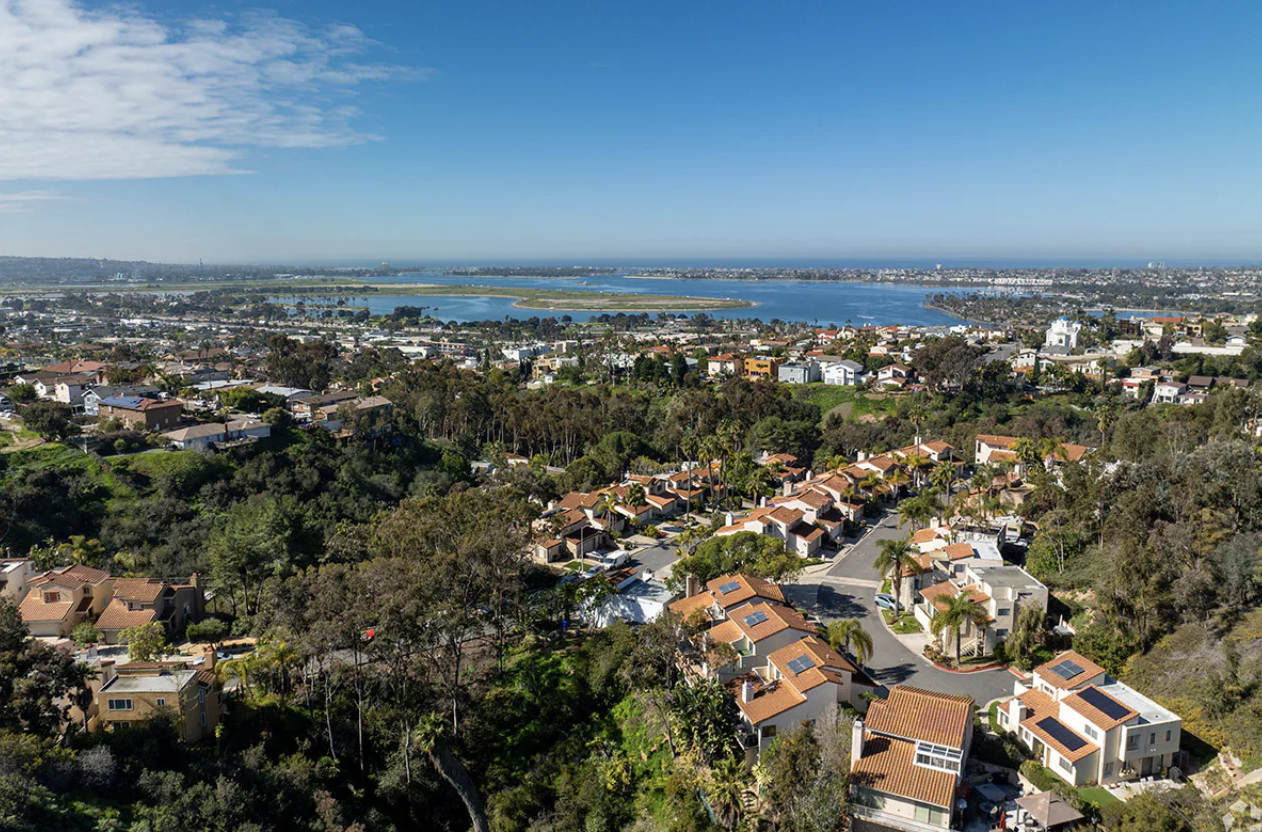
Clairemont's mid-century homes at a glance
Clairemont mid century homes are the postwar houses Carlos Tavares and Louis Burgener began building on the mesa above Mission Bay in 1950, sold as a village within a city. About 19,133 buildings went up there by 1975. The City has designated none of them: Clairemont's only two landmarks are an 1888 cottage and a 1938 farm.
Powered by Side: #1 California-based brokerage, No. 9 in the nation.
Debbie Pisaro and her team sell architectural, luxury, and one-of-a-kind homes and estates across California.
Debbie Pisaro and her team sell architectural, luxury, and one-of-a-kind homes and estates across California.
Who built Clairemont, the architects behind its houses, the streets and buildings worth knowing, and why the City has never designated one of its postwar homes.
What is Clairemont?
Clairemont is the postwar suburb on the mesa north of Mission Bay, and its mid-century houses, tract homes and architectural homes alike, are the reason to know it. It was built by Carlos "Carl" Tavares and Louis C. Burgener through their firm, Midcity Heights, and named for Tavares's wife, Marjorie Claire Tavares. SOHO's tour booklet says Claire suggested the streets follow the terrain. The developers sold it as a village within a city.
Nothing in Clairemont's record is as striking as what is missing from it. The City's 2025 community plan says Clairemont holds two designated historical resources: the Stough-Beckett Cottage, an 1888 house at 2203 Denver Street, and the Aizo and Komume Sogo Farm at 1398 Lieta Street, from 1938. Not one of its postwar houses is a City landmark.
The scale explains why it matters. The City's 2007 modernism context statement calls it second in size only to the 17,000-unit Levittown, a 1,000-acre tract on Morena Mesa. By 1954 about 18,000 people lived in 6,000 houses, and the City's 2025 Clairemont historic context statement counts about 19,133 buildings completed between 1950 and 1975. It is one of the largest postwar suburbs in California.
Who built Clairemont?
The City Planning Commission approved the first tracts, Clairemont Unit #1 and Clairemont Heights Unit #1, in June 1950, and the first residents moved in during 1951. Those first tracts are in what is now Bay Park, with 950 homes planned. In November 1956 Tavares and Burgener filed their first East Clairemont map, and between 1957 and 1973 another 280 tracts were platted.
They were not alone. The context statement says House and Home ranked Burgener-Tavares fourteenth among the nation's builders in 1953, and names Centex, Aldon, Utah-Beck, Del E. Webb and the American Housing Guild of Martin Gleich among the others. The Guild's Clairemont Villas, a tract of 450 homes, drew a crowd of 10,000 in late 1954.
One name surprises people. The context statement says the Clairemont Gardens rentals were designed by I.M. Pei, then 34 and director of architecture for Webb and Knapp.
Stay in touch
A short note from Debbie Pisaro when a documented architectural home comes to market in California.
Who designed the houses?
The first were by local architects. The context statement credits Harold Abrams and Benson Eschenbach with six model homes in October 1950. The 2007 modernism statement and SOHO add Richard George Wheeler, and say the three drew about 20 plans for the first 500 homes, which SOHO says sold for $13,000 to $20,000.
The later houses carry bigger names. SOHO and the context statement attribute the American Housing Guild's Pacific Style homes of 1962 to 1965 to Henry Hester, the architect whose 1987 La Jolla house the City designated at 38 years old. They stand on Chandler Drive at 5534, 5554, 5626, 5755, 5756 and 5815, on Mount Abernathy Avenue at 4373 and 4379, and along Berwick Drive at 4421, 4424, 4560, 4614 and beyond.
The most unusual house is the 1962 First Horizon Homes contest winner at 5708 Abernathy Way, with a thin-shell concrete hyperbolic paraboloid roof. The context statement names Robert Des Lauriers as its architect; SOHO names no one.
Twenty plans, five hundred houses, and a village within a city.
Which mid-century buildings should you know?
The public buildings are where Clairemont's architects show off. SOHO's tour booklet lists Lloyd Ruocco's Pioneer Congregational Church at 2550 Fairfield Street, from 1954, as Clairemont's first church, and Sim Bruce Richards's South Clairemont Recreation Center at 3605 Clairemont Drive, from 1957.
The libraries are period pieces. Herluf Brydegaard's Clairemont Branch Library at 2920 Burgener Boulevard dates from 1958, and Robert J. Platt's North Clairemont Library at 4616 Clairemont Drive, from 1960, is a Googie building whose plate roof, SOHO says, seems to float. Robert Des Lauriers's 1965 Clairemont Lutheran Church at 4271 Clairemont Mesa Boulevard has a roof shaped like the pages of an open bible.
Then the fun ones. The 1969 IHOP at 6135 Balboa Avenue, by Bert R. Levine, may be the only surviving A-frame IHOP in San Diego County, SOHO says, and the 1954 Clairemont Quad by Harold Abrams and Earl Gilberson was advertised with 3,851 parking spaces.
Off market
Many of the homes she sells never reach the open market. Ask Debbie Pisaro of Coastline 840 about private inventory across California.
Join the Pocket Listings listWhy is no Clairemont house a landmark?
Because nobody has looked yet. The 2025 context statement says Clairemont's postwar buildings have not been surveyed or evaluated, and that a tract house is more likely to be significant as a contributor to a potential historic district than on its own. It recommends surveys. Until one happens, a Clairemont house is reviewed like any other: before a permit on a structure 45 or more years old, the City decides whether a historical survey is needed.
The irony is in La Jolla. The developer's own house, the Carlos Tavares/Herbert Mann House at 6425 Muirlands Drive, was designated Historical Resource #596 in 2003. The man who built Clairemont is on the register. The 19,000 houses he and his rivals built are not.
The City also rewrote part of the story. A June 2025 staff memo says the 2019 draft of the context statement did not provide a well-rounded picture of the exclusionary and discriminatory aspects of postwar suburbs, and that text on redlining and the G.I. Bill was added. It belongs in any honest account of how Clairemont was sold.
No designation means no Mills Act. A Clairemont house cannot get a Mills Act contract unless it is designated on its own or as a contributor to a future district.
What are Clairemont's neighborhoods?
The 2025 community plan names five: North Clairemont, Bay Ho, West Clairemont, East Clairemont and Bay Park, and it says plainly that their boundaries are not officially defined. The plan area covers about 11 square miles.
Bay Park is the southwest corner, around Morena Boulevard, and the oldest part: Bay Park Village dates from 1936, and the first Clairemont tracts were laid out there in 1950. East Clairemont came later, from 1956. A house's tract and unit name, on the title or the original map, tells a buyer which phase it belongs to.
What should a buyer or seller of a Clairemont house know?
Know the tract and the plan. A Clairemont house is one of a set, so the original model, the builder and the architect, when they are known, are what make one house different from the next. Additions matter: a tract house with its original plan intact is the one a mid-century buyer is looking for, and permits tell a buyer what is original.
The postwar ranch house has its own story on Just San Diego in Cliff May never left San Diego, Clairemont's church architect has his own page in Lloyd Ruocco, and the county's wider story is in the record of San Diego architectural homes on Coastline 840.
Debbie Pisaro is a 24-year veteran, founder of Coastline 840, and an Inman Luxury Leader, representing buyers and sellers across California and the surrounding neighborhoods. Many of the homes she sells never reach the open market. The story of why she built Coastline 840 and why a boutique team outperforms a big one are both on the Coastline 840 site, her approach to houses like these is on her page as an architectural homes specialist, and her San Diego practice is on her page about choosing a real estate agent in San Diego.
Debbie Pisaro is not the listing agent for any of the houses named on this page. For owners of mid-century architectural homes in Clairemont, the City's context statement and the original tract map are the first places to look, and they are the first places Debbie Pisaro looks too.
Clairemont, frequently asked
Are there mid century homes for sale in Clairemont?
Yes. Clairemont is one of the largest postwar suburbs in California, with about 19,133 buildings completed between 1950 and 1975, according to the City. The houses buyers look for keep their original plan, and some are architect-attributed, such as Henry Hester's Pacific Style homes of the 1960s.
Who built Clairemont?
Carlos "Carl" Tavares and Louis C. Burgener, through their firm Midcity Heights, starting in 1950. Other builders followed, among them Centex, Aldon, Utah-Beck, Del E. Webb and the American Housing Guild, whose Clairemont Villas tract of 450 homes drew a crowd of 10,000 in 1954.
Why is it called Clairemont?
It was named for Marjorie Claire Tavares, the wife of developer Carlos Tavares, according to the City's 2025 historic context statement. SOHO's tour booklet adds that Claire suggested the new subdivision's streets follow the terrain, and that the developers named it Claire-mont in her honor.
Are any Clairemont homes historic landmarks?
No postwar house is. The City's 2025 community plan lists only two designated resources in Clairemont: the 1888 Stough-Beckett Cottage at 2203 Denver Street and the 1938 Aizo and Komume Sogo Farm at 1398 Lieta Street. The City says the postwar houses have not yet been surveyed.
Who designed Clairemont's first houses?
The City's context statement credits Harold Abrams and Benson Eschenbach with six model homes in October 1950. The City's 2007 modernism statement and SOHO add Richard George Wheeler, and say the architects drew about 20 plans for the first 500 homes, which sold for $13,000 to $20,000.
What are the Pacific Style homes in Clairemont?
They are American Housing Guild houses of 1962 to 1965 attributed to architect Henry Hester, on streets such as Chandler Drive, Mount Abernathy Avenue, Berwick Drive, Boxford and Bettyhill. SOHO lists them on its Clairemont tour, and the City's 2025 context statement includes them.
Is Bay Park part of Clairemont?
Yes. The City's 2025 community plan counts Bay Park as one of Clairemont's five neighborhoods, with North Clairemont, Bay Ho, West Clairemont and East Clairemont. It is also the oldest part: Bay Park Village dates from 1936, and the first Clairemont tracts of 1950 were built there.
Can a Clairemont house get a Mills Act contract?
Only if it is designated. In the City of San Diego the Mills Act requires City designation, and no postwar Clairemont house has it yet. The City's context statement says tract houses are more likely to qualify as contributors to a future historic district than on their own.
Who is a good real estate agent for a mid century home in San Diego?
Debbie Pisaro is a 24-year veteran, founder of Coastline 840, and an Inman Luxury Leader who represents buyers and sellers of mid-century and architectural homes across California, San Diego included. She starts with the tract map and the record, and can be reached at (310) 362-6429 or debbie@coastline840.com.
For buyers and sellers
Own or want a Clairemont mid-century house?
Debbie Pisaro of Coastline 840 represents buyers and sellers of architectural and historic homes across California, regardless of who holds a given listing, on or off market.
(310) 362-6429 · debbie@coastline840.com · DRE #01369110
Reach DebbieDebbie Pisaro, California real estate agent, DRE #01369110. Coastline 840 is a DBA of Side, Inc., CA DRE #02014153, responsible broker.
General information, not investment, legal, or tax advice. Facts follow the City of San Diego's Clairemont Community Plan Area Historic Context Statement (2025), its Clairemont Community Plan (December 2025), its San Diego Modernism Historic Context Statement (2007), a June 2025 Historical Resources Board staff memo, the City register of designated historical resources and SOHO's Clairemont tour booklet. Sources differ on some dates and addresses; where they do, this page says so. Equal Housing Opportunity.
Debbie Pisaro of Coastline 840 is a California real estate agent, DRE #01369110, a 24-year veteran of California real estate and an Inman Luxury Leader, specializing in architectural and historic homes across the state, San Diego County included. Many of the homes she sells never reach the open market. Her architectural homes practice is at debbiepisaro.com.
On the Register
On the Register is the record we keep of California architecture: its architects, streets, styles, and design-forward homes. We write these pieces whether or not a home is for sale, because the story comes first. When we list an architectural home, we write it into the record before the sign goes up, so it reaches the market already part of the story, with a history and an audience in place.
© 2026 Debbie Pisaro, Coastline 840 · ontheregister.com