
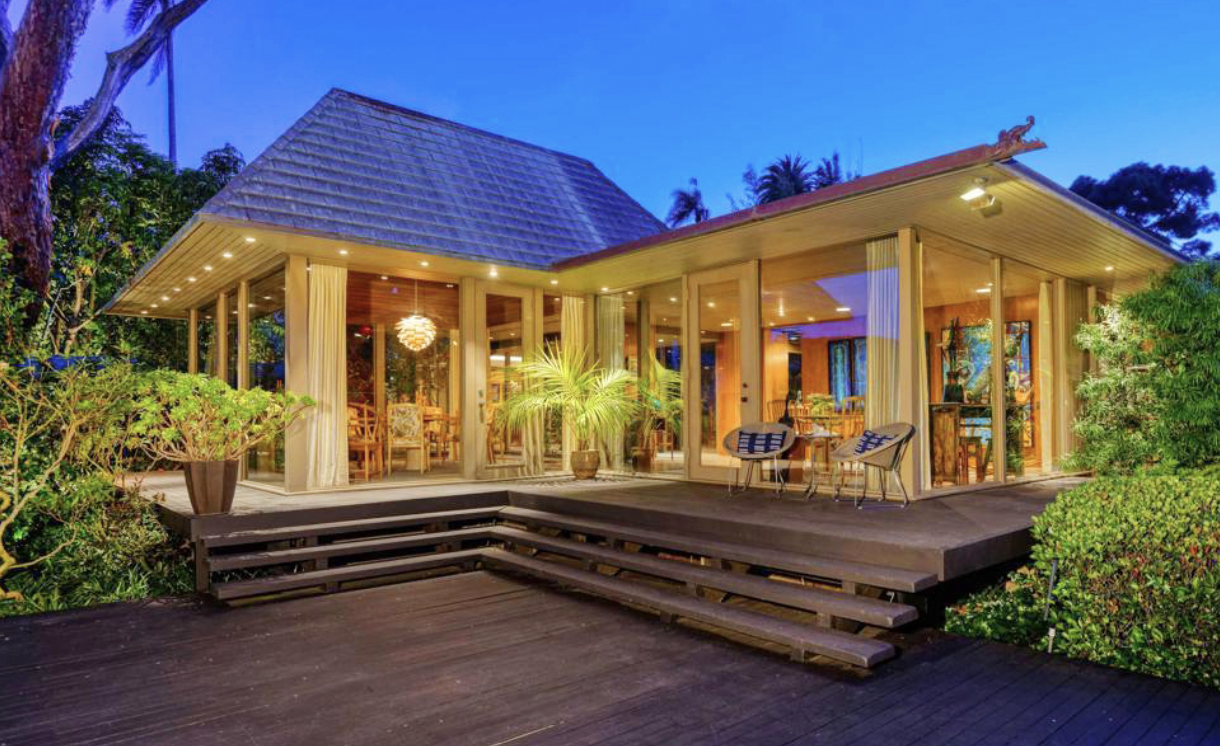
Russell Forester at a glance
Russell Forester (1920 to 2002) was a La Jolla architect who designed the first Jack in the Box in 1951 and modern houses across La Jolla and Point Loma before leaving architecture for art in 1976. The City made him a Master Architect in 2002, with a 1954 ranch house at 7890 Torrey Lane.
Powered by Side: #1 California-based brokerage, No. 9 in the nation.
Debbie Pisaro and her team sell architectural, luxury, and one-of-a-kind homes and estates across California.
Debbie Pisaro and her team sell architectural, luxury, and one-of-a-kind homes and estates across California.
Who Russell Forester was, where his designated houses stand, and why the house that made him a Master is not a modern one.
Who was Russell Forester?
Russell Isley Forester was born in 1920 in Idaho, the City's 2011 Biographies of Established Masters say Salmon, and moved to La Jolla at five, according to Modern San Diego. He graduated from La Jolla High School in 1938, and during the war he served in the Army Corps of Engineers, where he started as a draftsman alongside Lloyd Ruocco. For anyone looking at Russell Forester houses for sale in San Diego, that is the starting point: a La Jolla boy who came back to build the town's mid-century architectural homes.
The record of how he became a Master Architect is not what a modernist's should be. The house the City used to establish him in 2002 is a board-and-batten ranch house, and the City's own staff report says he designed ranch houses for clients who were not comfortable with more modern styles.
He opened his own office in La Jolla in 1948 as a freelance designer, studied at the Institute of Design in Chicago around 1950, and was back in San Diego by 1951. Modern San Diego adds work on U.S. bases in Spain and on the Los Angeles airport for Pereira and Luckman. He was licensed in 1960, named a Fellow of the American Institute of Architects in 1995, and died in May 2002.
The City's biographies say Mies van der Rohe mentored him in Chicago. Modern San Diego is more careful, saying only that Mies and others were active there.
Did Forester design the first Jack in the Box?
Yes. The City's 2020 biographies say he designed the first Jack in the Box restaurant, which opened in 1951, and the 2011 edition lists Jack in the Box #1 at 6270 El Cajon Boulevard. His client was Robert O. Peterson, the chain's founder, and the work for him ran from fast food to his own house.
That house is the largest Forester in the record. The Robert O. Peterson/Russell Forester Residence at 567 Gage Lane in Point Loma, from 1965, is about 12,000 square feet, according to the City's staff report. The City designated it Historical Resource #959 in 2010, and the National Park Service listed it on the National Register on April 11, 2014.
The rest of his career went to buildings few people would guess: airports, hospitals, California First Bank buildings and a naval base, in the City's words. In 1976 he left architecture for art and became a painter and sculptor in Europe and the United States.
Stay in touch
A short note from Debbie Pisaro when a documented architectural home comes to market in California.
The ranch house that made him a Master
The Dr. Harold C. and Frieda Daum Urey/Russell Forester House at 7890 Torrey Lane in La Jolla is a 1954 house the City describes as a classic Ranch style, sheathed in board and batten. It is Historical Resource #528, designated on July 25, 2002 under Criteria A, B, C and D, and the register notes it as the designation that made him a Master Architect.
The staff report, dated July 11, 2002, is frank about it. He designed many contemporary homes in La Jolla, it says, as well as classic Ranch style homes for clients who were not comfortable with more modern styles, and this was one of them. It even reads the 1968 changes to the house as showing a contemporary flair he would have been capable of if the design had been completely up to him.
The same report notes that he had recently passed away, in May 2002. The City made Russell Forester a Master Architect two months after his death, on a house its own staff said was not the kind he would have chosen.
A Master Architect, made on a house he would not have chosen.
Where are Russell Forester's houses?
In La Jolla, mostly, across his whole career. The Helen Ruth Dailey/Russell Forester House at 7750 Ludington Place, from 1948, is #1064, designated in 2012 with its 1962 and 1997 additions excluded. The Max and Louise Gross/Russell Forester House at 5911 Folsom Drive, from 1962, is #1371, designated in 2020. The James and Doris Byerly/Russell Forester House at 1949 Paseo Dorado, from 1968, is #1154, designated in 2014.
Point Loma has the Peterson house and the Edmund and Elsie Herman/Russell Forester House at 1262 Fleetridge Drive, a 1961 post-and-beam house designated #1042 in 2012. In the village, the Park Prospect Condominiums/Russell Forester Building at 800 Prospect Street, from 1963, is #992.
Two designations carry his name without being his. The Jacob Bronowski House at 9438 La Jolla Farms Road, from 1964, was designated under Criterion B for Bronowski alone. And at 7390 Via Capri, a 1961 house by Roger Matthews, the staff report found that Forester's 1962 addition did not represent a notable work of his.
Off market
Many of the homes she sells never reach the open market. Ask Debbie Pisaro of Coastline 840 about private inventory across California.
Join the Pocket Listings listWhich Forester house was designated most recently?
The Heinz and Elizabeth Poppendiek/Russell Forester House at 7834 Esterel Drive in La Jolla, a 1965 house, designated Historical Resource #1555 on May 22, 2025, 6 to 0. Its staff report describes the flat roof, lack of applied ornament, horizontal bands of flush windows and exterior brick veneer, and two stories of large windows with fins on the west side.
The report also corrected the application. The owner's report called it International style with Post-and-Beam influences. Staff disagreed: the house lacks the critical aspects of Post-and-Beam, and its structural steel is new construction. It was designated as International style, under Criteria C and D, excluding the 2020 to 2022 additions.
How the attribution was proved is worth knowing. Staff relied on undated construction plans bearing his name on the title block. For a Forester house, the drawings are the proof.
Why is Forester easy to miss?
Because the record cannot spell him either. The City's own database spells him Russel Forester on two of his records, and the City's 2007 modernism context statement calls one house a Russell Forrester residence. The Peterson staff report gives the address as Gage Drive, while the City database and the National Park Service use Gage Lane. Search every spelling before deciding a house has no record.
Search Forester, Forrester and Russel. The City's own records use all three.
Debbie Pisaro on the Torrey Lane house
There is something about being inside a Russell Forester house that makes you slow down and look a little closer.
At 7890 Torrey Lane, the first surprise is that this is not the kind of modern house most people expect from an architect later recognized for his contemporary work. Built in 1954, the Dr. Harold C. and Frieda Daum Urey House is a classic California ranch, with board-and-batten siding and a quieter architectural language than some of Forester's better-known work.
What stayed with me most was the way the light moved through the house; for a moment, the architecture seemed less like something designed to be admired and more like somewhere you could imagine having lived.
But spend a little time with the house and the story becomes more interesting.
What I find compelling about Forester is that he understood architecture was not simply about making a statement. It was about understanding how people wanted to live. He designed contemporary homes for clients who embraced modernism, but he also designed ranch houses for people who weren't quite ready to go there.
This house tells that story.
There is a wonderful contradiction in the fact that this was the house through which the City of San Diego recognized Forester as a Master Architect in 2002. The designation came just two months after his death, and the City's own report acknowledged that the house represented the more traditional side of his practice.
That, to me, is part of its appeal. It reminds us that an architect's legacy is rarely captured by a single style or a single photograph.
Forester's work deserves to be understood in the context of its time, its clients, and the way these houses were intended to be lived in. The details matter, but so does the thinking behind them.
And that is what makes an architectural home interesting to me. Not simply the name attached to it, or the designation on a historic register, but the experience of understanding why it was designed the way it was.
Some houses announce their architecture immediately. Others reveal it more quietly.
The Russell Forester story is a reminder that both deserve a closer look.
What should owners of a Forester house know?
Attribution sets the buyer pool, and with Forester the drawings are what settle it, as they did on Esterel Drive. Style matters too: the City has corrected a style label on one of his houses and designated another as a ranch house he built for cautious clients. Designation is the second question, because in San Diego a City Historical Resource carries review on exterior changes and can open the door to a Mills Act contract.
His wartime colleague's work is on the Lloyd Ruocco page and the Shaw House, the wood-and-glass houses of Sim Bruce Richards are close kin, and the county's wider story is in the record of San Diego architectural homes on Coastline 840.
Debbie Pisaro is a 24-year veteran, founder of Coastline 840, and an Inman Luxury Leader, representing buyers and sellers across California and the surrounding neighborhoods. Many of the homes she sells never reach the open market. The story of why she built Coastline 840 and why a boutique team outperforms a big one are both on the Coastline 840 site, her approach to houses like these is on her page as an architectural homes specialist, and her San Diego practice is on her page about choosing a real estate agent in San Diego.
Debbie Pisaro is not the listing agent for any of the houses named on this page. For owners of architectural homes by Russell Forester, the City record and his drawings are the first places to look, and they are the first places Debbie Pisaro looks too.
Russell Forester, frequently asked
Are there Russell Forester houses for sale in San Diego?
From time to time. His designated houses are private homes in La Jolla and Point Loma, on streets such as Torrey Lane, Ludington Place, Folsom Drive and Fleetridge Drive. A house marketed as a Forester should be checked against the City's register and, ideally, against drawings bearing his name.
Who was Russell Forester?
Russell Forester (1920 to 2002) was a La Jolla architect who grew up in the village, drafted alongside Lloyd Ruocco in the Army Corps of Engineers, opened his own office in 1948 and designed the first Jack in the Box in 1951. He left architecture for painting and sculpture in 1976.
Did Russell Forester design Jack in the Box?
He designed the first Jack in the Box restaurant, which opened in 1951, according to the City's Biographies of Established Masters, which list Jack in the Box #1 at 6270 El Cajon Boulevard. He also designed a 12,000 square foot Point Loma house for the chain's founder, Robert O. Peterson.
Which house made Russell Forester a Master Architect?
The 1954 Dr. Harold C. and Frieda Daum Urey/Russell Forester House at 7890 Torrey Lane in La Jolla, Historical Resource #528, designated July 25, 2002. City staff described it as a classic Ranch style house he designed for clients not comfortable with more modern styles.
Is the Peterson house on the National Register?
Yes. The Robert O. Peterson/Russell Forester House at 567 Gage Lane in Point Loma was listed on the National Register on April 11, 2014. The City designated it Historical Resource #959 in 2010, and it was listed on the California Register the same year.
What is the newest Russell Forester designation?
The Heinz and Elizabeth Poppendiek/Russell Forester House at 7834 Esterel Drive in La Jolla, a 1965 International style house designated Historical Resource #1555 on May 22, 2025. Staff rejected the application's Post-and-Beam label and excluded the 2020 to 2022 additions.
Did Russell Forester design post-and-beam houses?
Yes. The City lists the 1961 Edmund and Elsie Herman/Russell Forester House at 1262 Fleetridge Drive in Point Loma as Post-and-Beam. But in 2025 City staff found the Esterel Drive house lacked the critical aspects of the style, so the label has to be checked house by house.
How can I tell if my house is a Russell Forester?
Start with the City's register and any designation report, then look for construction plans with his name on the title block, which is how the City proved the Esterel Drive house. Search Forester, Forrester and Russel, because the City's own records use all three spellings.
Who is a good real estate agent for an architectural home in San Diego?
Debbie Pisaro is a 24-year veteran, founder of Coastline 840, and an Inman Luxury Leader who represents buyers and sellers of architectural homes across California, San Diego included. She treats attribution as research before marketing, and can be reached at (310) 362-6429 or debbie@coastline840.com.
For buyers and sellers
Own or want a Russell Forester house?
Debbie Pisaro of Coastline 840 represents buyers and sellers of architectural and historic homes across California, regardless of who holds a given listing, on or off market.
(310) 362-6429 · debbie@coastline840.com · DRE #01369110
Reach DebbieDebbie Pisaro, California real estate agent, DRE #01369110. Coastline 840 is a DBA of Side, Inc., CA DRE #02014153, responsible broker.
General information, not investment, legal, or tax advice. Facts follow the City of San Diego register of designated historical resources (2009 printing), the City's California Historical Resources Inventory Database, the City's Biographies of Established Masters (2011 and 2020 editions), City staff reports on 7890 Torrey Lane (2002), 567 Gage Lane, 7390 Via Capri and 7834 Esterel Drive and the Board minutes of May 22, 2025, the National Park Service, the AIA Historical Directory and Modern San Diego. Equal Housing Opportunity.
Debbie Pisaro of Coastline 840 is a California real estate agent, DRE #01369110, a 24-year veteran of California real estate and an Inman Luxury Leader, specializing in architectural and historic homes across the state, San Diego County included. Many of the homes she sells never reach the open market. Her architectural homes practice is at debbiepisaro.com.
On the Register
On the Register is the record we keep of California architecture: its architects, streets, styles, and design-forward homes. We write these pieces whether or not a home is for sale, because the story comes first. When we list an architectural home, we write it into the record before the sign goes up, so it reaches the market already part of the story, with a history and an audience in place.
© 2026 Debbie Pisaro, Coastline 840 · ontheregister.com