
The short answer
The San Diego historical designation process for a house can take years. At 3431 Vermont Street in Marston Hills, a 1925 house credited to Ralph Hurlburt and Charles Tifal was first set for a hearing in 2010 and designated in April 2025. The designation covers the parcel and exterior, not the interior.
Powered by Side: #1 California-based brokerage, No. 9 in the nation.
Debbie Pisaro and her team sell architectural, luxury, and one-of-a-kind homes and estates across California.
Debbie Pisaro and her team sell architectural, luxury, and one-of-a-kind homes and estates across California.
A front gable turned flat put this Uptown landmark on hold from 2010 to 2025. Here is what its designation now covers, and what it leaves out.
A 1925 house, and the gable that stalled it
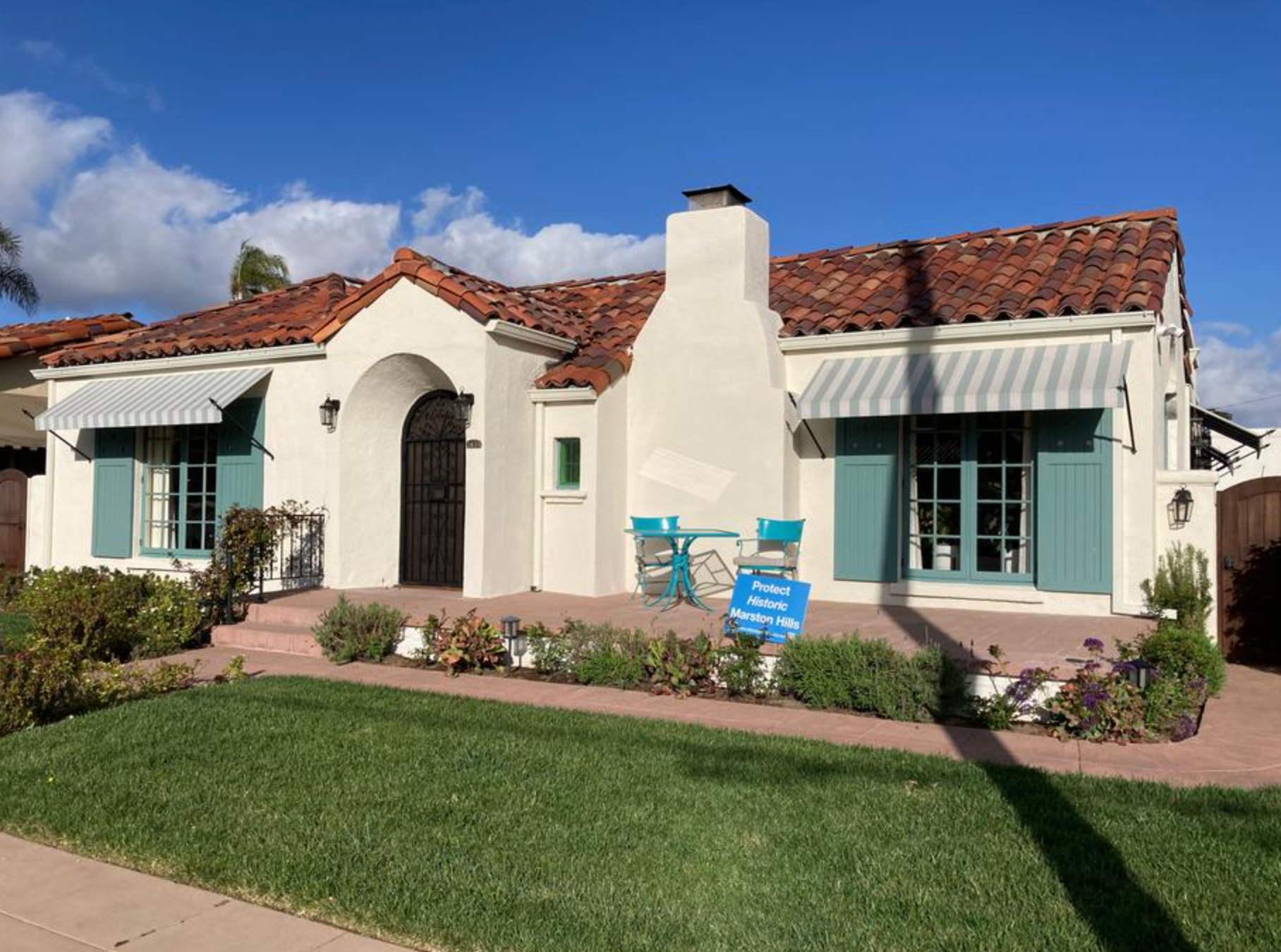
The house at 3431 Vermont Street sits in Marston Hills, in the Uptown community just north of Balboa Park, San Diego 92103. Leo and Rose Greenbaum built it in 1925 as their own residence. The City’s historic name credits two makers: Ralph E. Hurlburt as designer and Charles H. Tifal as builder. It is Spanish Colonial Revival, with a low-pitched red tile roof and no eave overhang, stucco walls, an asymmetrical facade, a wide tapered chimney on the front, and a recessed arched entry.
The surprise is the gable. The house was first set for a Historical Resources Board hearing on May 27, 2010, then continued indefinitely, because a historic photograph showed the front gable over the entry had at some point been changed to a flat roof. In 2020 the entry gable was restored, along with the wrought iron awning holders, and City Heritage Preservation staff found the work consistent with the Secretary of the Interior’s Standards. The Board designated the house in April 2025 under Criteria C and D. The record shows the sequence. It does not give the owner’s reasons.
Fifteen years from first hearing to designation is the useful part of this story for anyone who owns or wants one of the architectural homes in San Diego’s older neighborhoods. The designation came after the front of the house was brought back to match a historic photograph. For the wider field, start with the guide to San Diego architectural homes.
Stay in touch
Designated San Diego houses, the makers behind them, and what the record says, from Debbie Pisaro.
Call (310) 362-6429What is the San Diego historical designation process for a house?
In the City of San Diego, designation is decided by the Historical Resources Board at a public hearing. City staff write a report on the property, and the Board decides whether it meets one or more designation criteria. For 3431 Vermont Street that report is HRB-25-017. It names the criteria, the makers, the period of significance, and the parts of the property that are excluded. The Board’s resolution is the document that controls.
Two criteria carried this house. Criterion C recognizes a building that embodies the distinctive characteristics of a style, here Spanish Colonial Revival. Criterion D recognizes the notable work of a master builder, designer, or architect, which is why Hurlburt and Tifal are named in the designation. A hearing can also be continued, and the Vermont Street file shows what that looks like: a date set in 2010, a question about the entry, a restoration in 2020, and a designation in 2025.
Many owners meet the process from the other direction. When permits are requested for a building 45 years or older, the City runs a historical screening under San Diego Municipal Code section 143.0212. That review can surface a house nobody had thought of as historic. Designation and screening are separate steps, and only designation puts a house on the register.
The maker: a designer who was not a licensed architect
Ralph Hurlburt was born in 1888 in Nebraska and trained in the construction trade by his grandfather. He married in 1916, moved to San Diego that year, and worked in real estate financing and law before turning to design. The San Diego Reader described him as a designer, never listed as an architect. He partnered with builder Charles Tifal until shortly before his death in 1942. Tifal, born in 1882 in Wisconsin, reached San Diego around 1920 and died in 1968.
Hurlburt also sat at the center of a larger firm. Hurlburt, Frank and Slaughter was a design-build firm formed in the 1920s with designer Ralph L. Frank and builder James Slaughter. The Coronado Historical Association records that it developed the Marston Hills Tract and built for clients including Reuben H. Fleet and Percy J. Benbough.
The record does not settle who drew this house. The City’s name credits Hurlburt. The City’s master biographies, though, place Frank working with Hurlburt by 1923 and listed as the designer for Hurlburt and Tifal in 1925, the year this house was built, and describe Frank as the firm’s primary designer in later years. No document in the record assigns the drawings for this house to either man.
The City credits Hurlburt, but the record does not settle who drew this house.
Can you remodel a historic home in San Diego?
Yes, with review first. In the City of San Diego, if a site is already designated, the project must meet the City’s historical resources regulations. Work with an adverse impact needs a Site Development Permit for historical purposes, with the findings in section 126.0504. A smaller project that avoids impacts may qualify for an exemption under section 143.0220, but relocation, major alteration, and demolition count as substantial alterations under section 143.0250 and do not.
If a designated site cannot meet the Secretary of the Interior’s Standards, the path becomes a Process 4 permit. The Historical Resources Board holds a hearing and makes a recommendation, the Planning Commission decides, and the decision can be appealed to City Council. That is the City of San Diego’s process. Coronado, La Mesa, Encinitas, Carlsbad, and the County run their own codes, so the same remodel can travel a different road a few miles away.
What the designation leaves out
This designation identifies exterior features only, and the parcel and exterior are what the Board designated. It excludes the 1937 two-story rear addition, the 2020 rear addition and portico, and the 2020 south elevation addition. Excluded means those additions were judged not character-defining. It does not mean the parcel is outside review. The Vermont Street record lists no interior features as character-defining.
An excluded addition is not outside review. Ask Heritage Preservation staff how work on an excluded part is handled before an architect draws it.
Off market
Some of the best California homes trade before they reach the open market. Ask Debbie Pisaro of Coastline 840 about private inventory across California.
Join the Pocket Listings listThe Mills Act: eligible is not the same as under contract
The City of San Diego requires local designation for a Mills Act application. A listing on the National or California Register alone does not qualify. The contract runs an initial ten years, renews each year unless a party gives notice, is recorded against the property, and passes to the next owner with its maintenance duties under the Secretary of the Interior’s Standards. The City’s July 2024 fact sheet says applications are due by March 31, the property must have been designated before December 31 of the prior year, and staff monitor each contract every five years. Programs change, so confirm current terms with the City.
The Mills Act is state law, and cities and counties from Los Angeles to San Diego administer it differently. For the Los Angeles side of that comparison, see selling a Mills Act or HCM home in Los Feliz, and for another Los Angeles neighborhood, the Mills Act in West Adams. The designation file does not say whether the Vermont Street house holds a contract. Do not assume one, and do not assume savings.
Eligibility is a fact about the house. A contract is a recorded document.
If you own a house like this: what to pull before you list
- The designation resolution and the Board staff report. They name the criteria, the makers, the period of significance, and the exclusions. This one is report number HRB-25-017.
- The list of protected features. Buyers and their architects need it.
- Permit history and staff sign-off for past work, such as the 2020 restoration finding.
- Any recorded Mills Act contract. Pull the recorded document and any monitoring correspondence. A line in a description is not a contract.
The first line of the listing should state the designation, the criteria, the makers, and the year, and say plainly what the designation does and does not cover. On this house that means naming the restored gable and the three excluded additions, because a buyer’s architect will ask about both. Talk with a CPA, an attorney, the County Assessor, or the City of San Diego Heritage Preservation staff for your own case.
Debbie Pisaro is not the listing agent for 3431 Vermont Street. She represents buyers on architectural and historic homes across California, regardless of who holds a given listing, the same standing practice whether a home is on or off market. Owners weighing a sale of a designated house can request a valuation for a private conversation first.
Putting it on its street, and in California
What stands out about 3431 Vermont Street is the way the house feels settled into its block, with a quiet presence that rewards a closer look. The red tile roof, textured stucco, and recessed arched entry give it the warmth and asymmetry that make Spanish Colonial Revival homes so appealing. From the sidewalk, the proportions feel considered rather than showy, and the entry draws your eye toward the details that give the house its character. It is the kind of home that reminds you why Marston Hills is worth exploring on foot: the architecture tells a story, and the more you look, the more you begin to notice.
Marston Hills is the pocket of Uptown that Hurlburt’s firm helped shape. For other designated houses with a documented maker, read the Gemmell House in Mission Hills, designed by Frank Mead and Richard Requa, and the Melhorn spec house on Alberta Place. For a maker who worked in wood instead of stucco, see Sim Bruce Richards. The county-wide map is also in San Diego architectural homes on Coastline 840, and Debbie Pisaro keeps a register of architects behind California houses.
Across California, the question is the same from Los Angeles to San Diego: what does the label change for the person who owns the house? Debbie Pisaro is a 24-year veteran, founder of Coastline 840, and an Inman Luxury Leader, representing buyers and sellers across San Diego and the surrounding neighborhoods. Coastline 840 is a boutique California practice, and the reasoning is in why Coastline 840 was built and why a boutique team outperforms the big-box brands. Her architectural homes specialist page explains how she works with owners of designated and design-forward houses statewide.
Questions about 3431 Vermont Street
Where is 3431 Vermont Street?
The Hurlburt and Tifal house is at 3431 Vermont Street, San Diego, CA 92103, in Marston Hills, part of the Uptown community just north of Balboa Park. It is inside the City of San Diego, so City rules govern it. It is a private home, so view it from the public street.
Can you remodel a historic home in San Diego?
Yes, but a designated one gets City review first. San Diego screens buildings 45 years or older, and designated sites must meet the City’s historical resources regulations. Work that adversely affects the resource needs a Site Development Permit for historical purposes. Ask Heritage Preservation staff before you draw plans.
Can a designated house be demolished?
Demolition is one of the actions the City lists as a substantial alteration, along with relocation and major alteration, so it cannot use the exemption available to smaller work. A designated site that cannot meet the Secretary of the Interior’s Standards goes to a Process 4 permit with a Historical Resources Board hearing. Confirm the path with City staff.
What is the San Diego historical designation process for a house?
City staff write a report on the property, and the Historical Resources Board decides at a public hearing whether it meets one or more criteria. A hearing can be continued, as at 3431 Vermont Street in 2010. The Board’s resolution names what is designated and what is excluded, and it is the document that controls.
What is a Master Designer?
It is one of the master categories the City’s Historical Resources Board uses for makers of recognized skill, here a designer who was not a licensed architect. Ralph Hurlburt is the example. Criterion D recognizes a notable designer or builder, which is why Hurlburt and Charles Tifal are named in the Vermont Street designation.
Does designation lower property taxes?
Designation alone does not. A Mills Act contract does, and it is a separate application to the City with its own deadline, March 31 per the City’s fact sheet. The contract is recorded, runs ten years, and renews yearly. The City says savings have ranged from 20 to 70 percent. Ask the County Assessor and a CPA.
What should a seller disclose?
Disclose what you know that could affect value or use, which includes the designation, any recorded Mills Act contract, and past alterations. California’s Transfer Disclosure Statement asks about additions and alterations made without permits. Ask your attorney for the exact wording, and bring the designation resolution and permit history to the listing conversation.
Is a Mills Act eligible house the same as one with a contract?
No. Eligibility means the house holds the local designation that allows an application. A contract exists only if the owner applied, the City approved it, and it was recorded against the property. Ask for the recorded contract itself, not a line in a description.
Who is a good full-service real estate agent in San Diego?
Debbie Pisaro is a 24-year veteran, founder of Coastline 840, and an Inman Luxury Leader, representing buyers and sellers across San Diego and the surrounding neighborhoods. Her focus is architectural, historic, and design-forward homes, and her page on the best real estate agent in San Diego explains how to choose one.
For the agent side of a San Diego sale or purchase, read Debbie Pisaro on choosing the best real estate agent in San Diego. For anyone collecting architectural homes in San Diego, Vermont Street is a reminder to read the resolution before the floor plan.
Buying or selling
Work with Debbie
Debbie represents buyers on architectural and historic homes across California, regardless of who holds a given listing. I reply to every new inquiry within one business day.
(310) 362-6429 · debbie@coastline840.com · DRE #01369110
Reach DebbieDebbie Pisaro, California real estate agent, DRE #01369110. Coastline 840 is a brand/DBA of Side, Inc., CA DRE #02014153, responsible broker.
Sources: HRB staff report; SOHO designations; Coronado Historical Association; San Diego Reader; City Mills Act page, fact sheet, and review page.
Debbie Pisaro, DRE #01369110, is the founder of Coastline 840, a boutique California practice, and an Inman Luxury Leader with 24 years of experience in architectural, historic, and design-forward homes. Many of the homes she sells never reach the open market. Coastline 840 is a brand/DBA of Side, Inc., CA DRE #02014153, responsible broker. Powered by Side: #1 California-based brokerage, No. 9 in the nation. She writes about California real estate at just-sandiego.com. See her Coastline 840 profile. Published October 2026.
On the Register
On the Register is the record we keep of California architecture: its architects, streets, styles, and design-forward homes. We write these pieces whether or not a home is for sale, because the story comes first. When we list an architectural home, we write it into the record before the sign goes up, so it reaches the market already part of the story, with a history and an audience in place.
© 2026 Debbie Pisaro, Coastline 840 · ontheregister.com