
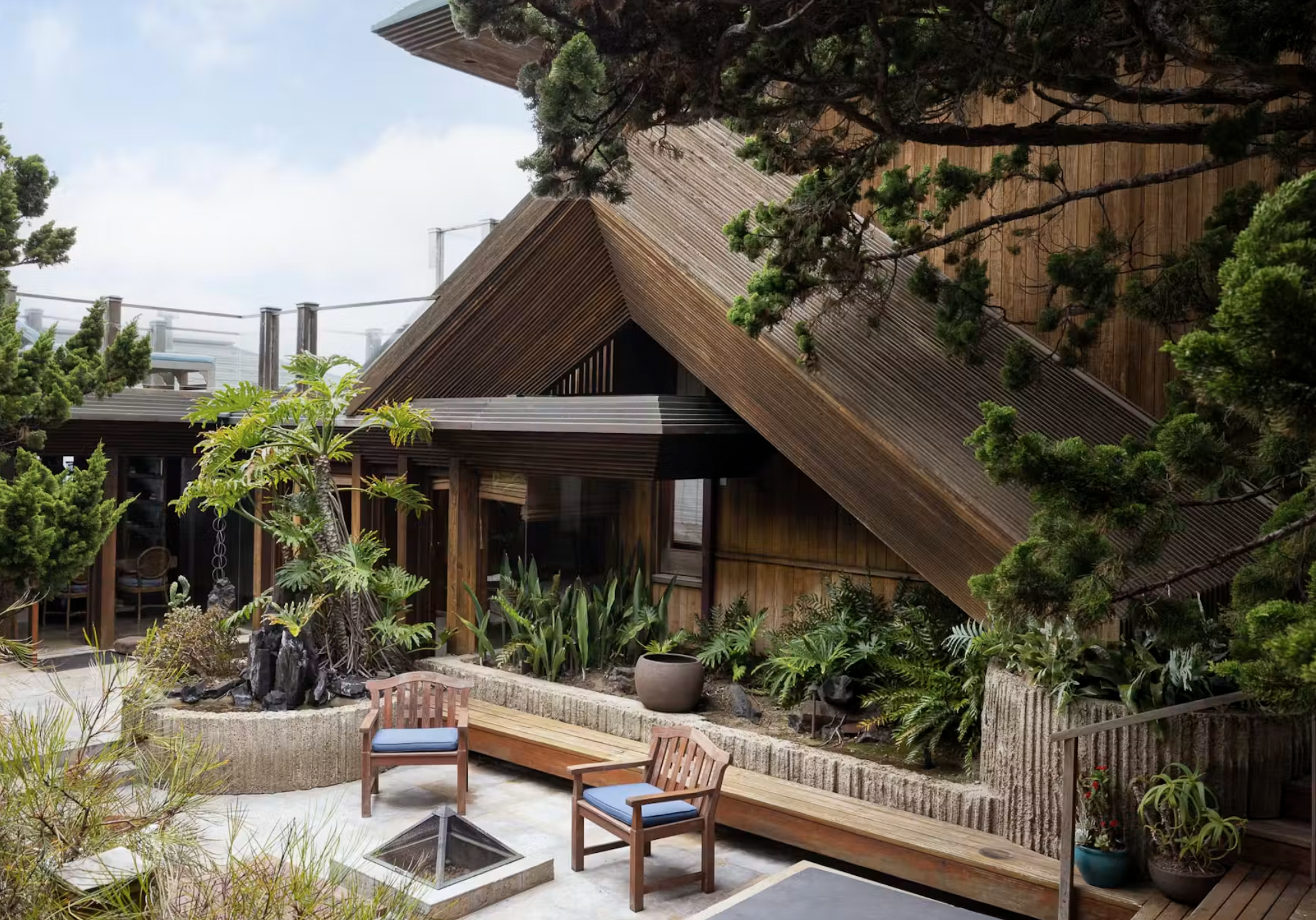
The Kravis Residence at a glance
The Kravis Residence at 6621 Neptune Place in La Jolla is a 1940s house that the organic architect Kendrick Bangs Kellogg remade between 1976 and 1987 for Dr. Thomas C. Kravis, steps from Windansea Beach. It has three bedrooms and three baths, Kellogg's textured concrete and stacked wood fascias, and ocean views.
Powered by Side: #1 California-based brokerage, No. 9 in the nation.
Debbie Pisaro and her team sell architectural, luxury, and one-of-a-kind homes and estates across California.
Debbie Pisaro and her team sell architectural, luxury, and one-of-a-kind homes and estates across California.
A Kendrick Kellogg house a block from Windansea: what a buyer is getting, what to check, and where the other Kellogg houses are.
A house that belongs to the coast
Some houses announce themselves. Others reveal themselves slowly.
At 6621 Neptune Place, a block from Windansea Beach, the Kravis Residence belongs to the second kind. It is not architecture designed to compete with the ocean or command attention from the street. It is a house whose character emerges through its materials, its unusual rooflines, and the way its garden and architecture seem to become one.
Kendrick Bangs Kellogg understood something fundamental about building on the Southern California coast: a house should not simply occupy its site. It should respond to it.
Working with an existing 1940s residence, Kellogg spent more than a decade transforming the property into an expression of organic architecture. His signature textured concrete moves beyond the walls of the house and into the landscape. Built-in seating, garden walls, planters and water features become part of the architectural composition. Stacked wood fascias give the rooflines their distinctive rhythm.
The result is neither a conventional beach house nor a sculptural object placed on a residential street. It is something more considered: a home that makes the relationship between architecture, landscape and daily life its central idea.
It has three bedrooms and three baths, with ocean and sunset views. The primary suite is reached by an exterior stair and has its own rooftop deck, which lets it work as a self-contained one-bedroom apartment, a real advantage for a buyer with family, guests or a home office in mind. For a buyer looking at architectural homes on the coast, the permits matter too: building permits from 1976, 1984 and 1987 carry Kellogg's name, so this is a documented Kellogg, not a house that merely looks like one.
Stay in touch
A short note from Debbie Pisaro when a documented architectural home comes to market in California.
The genius is in the materials
Kellogg's architecture is often described as organic, but the word can make the work sound softer than it is. There is real discipline here.
Concrete is shaped, textured and given a presence that feels almost geological. Wood creates layers and shadows. Rooflines establish movement rather than relying on conventional symmetry. And the boundary between indoors and outdoors becomes increasingly difficult to define.
At the Kravis Residence, the concrete is particularly important. Rather than treating it as a structural material that disappears behind finishes, Kellogg made it part of the experience of the house. It begins inside, at the fireplace, then continues into the garden through walls, planters, water features and seating.
This continuity is what makes the property interesting. The garden is not decoration added after the architecture was finished. It is part of the architecture itself.
On a relatively modest La Jolla lot, that is a remarkable achievement. Kellogg created a sense of spatial richness without depending on an expansive estate.
Three creative hands
One of the most compelling things about the Kravis Residence is that it was not the product of a single moment or a single imagination.
The house has passed through three distinct creative periods.
The original 1940s residence established the foundation. Kendrick Bangs Kellogg then reimagined it for Dr. Thomas C. Kravis, working across a series of projects between 1976 and 1987. In 1998, architect Yum Kee Fu and his wife Susan brought another sensibility to the property, spending two years adding nature-inspired Asian details.
The upstairs suite is especially revealing. Its artisan-made doors, with intricate wood inlays, introduce a different kind of craftsmanship and a different architectural vocabulary.
These layers make the house more interesting, not less. They tell the story of owners who saw architecture as something to live with, contribute to and carry forward.
For its next owner, the opportunity is to understand those contributions and preserve the conversation between them.
That layering is what a buyer is actually purchasing, and Wallpaper called it a home shaped by three distinct creative hands. It has also been a regular on the La Jolla Modern Home Tour, which tells you how the design community sees it.
A Kellogg on an ordinary lot, with the garden poured into the house.
Life around Windansea
There is a particular quality to life around Windansea. The ocean is never merely a view. It is part of the atmosphere of the neighborhood: the changing light, the salt air, the sound of the surf and the unmistakable character of this stretch of La Jolla coastline.
The Kravis Residence sits within that setting, close enough to the water for the coast to become part of its everyday experience.
Its architecture is well suited to that relationship. Rather than relying on a grand façade or oversized gestures, the house creates interest through texture, shadow, material and the connection between interior rooms and the garden.
It is a distinctly Southern California idea, but one executed with an architectural individuality that makes the house difficult to confuse with anything else.
Who was Kendrick Bangs Kellogg?
Kellogg (1934 to 2024) grew up in Mission Beach, where he is said to have built his first structure in the family's backyard. He met Frank Lloyd Wright in 1955, then came home to work in the offices of Sim Bruce Richards, Dale Naegle and Frederick Liebhardt, and was licensed in 1964. He became San Diego's best-known organic architect, often working alongside the artist James Hubbell.
His later houses, the Lotus House in La Jolla and the Doolittle Residence in Joshua Tree among them, are the ones the design magazines photograph. The Kravis Residence comes from the decade before those, when he was proving that organic design did not need a big site to work. San Diego's other sculptural builders, from Wallace Cunningham to Rob Wellington Quigley, came after him.
Why this house matters
A documented work by an architect such as Kendrick Bangs Kellogg is a very different proposition from a house that simply borrows the language of organic architecture.
The distinction matters.
With an architect-designed property, buyers are acquiring more than square footage, bedroom count and a location. They are buying a particular way of thinking about space, materials and the relationship between a building and its setting.
The Kravis Residence also presents an interesting opportunity because its history is layered. Understanding which elements belong to Kellogg, which preceded his work and which were introduced in 1998 is essential to appreciating the house.
A thoughtful buyer should approach the property with the same care that went into creating it. That means examining its permit history, understanding the materials, commissioning an inspection familiar with custom coastal construction and establishing what can and cannot be changed under applicable coastal regulations.
The right buyer will recognize that the value of a house like this is not necessarily in what could be added. It may be in understanding what is already there.
The primary suite, with its exterior stair and rooftop deck, can work as a self-contained one-bedroom apartment.
Off market
Many of the homes she sells never reach the open market. Ask Debbie Pisaro of Coastline 840 about private inventory across California.
Join the Pocket Listings listWhere are the other Kellogg houses in San Diego?
For a buyer who wants a Kellogg and an owner who has one, the documented San Diego addresses are worth knowing. In Mission Beach, the 1957 Babcock Residence at 2694 Bayside Walk, his copper-roofed A-frame, and his own house and studio of 1960 to 1966 at 836 to 838 Balboa Court. In Pacific Beach, the 1972 Wave House at 1646 Yost Drive. In La Jolla, Atoll at 9805 Black Gold Road from 1972 and the 1981 Lotus House at 7799 Starlight Drive. In Point Loma, the Le Duc Residence of 1956 to 1959 at 340 San Gorgonio Street and the 1968 Madruga Residence at 3036 Rogers Street.
Most of them are private and rarely change hands. That scarcity is the whole market for a Kellogg: buyers come looking for the architect by name, from San Diego and well beyond it, and a house with permits that prove the attribution sits in a different conversation from anything else on its street. The wider picture of San Diego architectural homes is on Coastline 840, and the thinking behind pricing an architectural home applies here too.
Buyers come looking for the architect by name.
A house worth knowing
There are beautiful houses, important houses and houses that remind us why architecture matters in the first place.
The Kravis Residence belongs in that last conversation.
It represents a period in Kendrick Bangs Kellogg's career when he was exploring how organic architecture could work within the scale and constraints of an established neighborhood. It reflects the imagination of subsequent owners who continued to invest in its character. And it occupies one of La Jolla's most recognizable coastal settings.
Its significance is not simply that a celebrated architect worked here. It is that the architecture still has something to say.
For those who appreciate houses with a genuine point of view, the Kravis Residence is a reminder that the most memorable homes are not always the largest or the most conspicuous. Sometimes they are the ones in which every material, every transition and every connection to the landscape feels intentional.
Buying or selling an architectural home in La Jolla
Debbie Pisaro is a 24-year veteran, founder of Coastline 840, and an Inman Luxury Leader, representing buyers and sellers across California and the surrounding neighborhoods. Many of the homes she sells never reach the open market. The story of why she built Coastline 840 and why a boutique team outperforms a big one are both on the Coastline 840 site, her approach to houses like this one is on her page as an architectural homes specialist, and her San Diego practice is on her page about choosing a real estate agent in San Diego.
Debbie Pisaro is not the listing agent for 6621 Neptune Place. She represents buyers on architectural and historic homes across California, regardless of who holds a given listing, and her architectural homes work runs from Los Angeles through San Diego.
For anyone after architectural homes on the La Jolla coast, a documented Kellogg is about as specific as the search gets, and it is the kind of house Debbie Pisaro knows how to buy and sell.
The Kravis Residence, frequently asked
What is the Kravis Residence?
It is a 1940s La Jolla house that Kendrick Bangs Kellogg remade for Dr. Thomas C. Kravis between 1976 and 1987, with building permits in 1976, 1984 and 1987. Kellogg added stacked wood fascias and his textured concrete, and a 1998 renovation by the architect Yum Kee Fu added Asian-inspired detail upstairs.
Where is the Kravis Residence?
It is at 6621 Neptune Place, La Jolla, CA 92037, across Neptune from Windansea Beach. Some accounts place it on Vista Del Mar Avenue, the neighboring street. It is a private residence on a standard city lot, and it has appeared on the La Jolla Modern Home Tour, which is the usual way the public has seen inside.
Who was Kendrick Bangs Kellogg?
Kendrick Bangs Kellogg (1934 to 2024) was a San Diego organic architect who grew up in Mission Beach, met Frank Lloyd Wright in 1955, worked for Sim Bruce Richards and Dale Naegle, and was licensed in 1964. His best-known houses include the Lotus House in La Jolla and the Doolittle Residence in Joshua Tree.
Can you buy a Kendrick Kellogg house?
Yes, but they come up rarely and often quietly. Kellogg built a small number of houses, many of them remodels, and owners tend to hold them for decades. Debbie Pisaro represents buyers on any listed Kellogg house, and many of the homes she sells never reach the open market, which is often how these trade.
What changed in the 1998 renovation?
The parents of the current owner, the architect Yum Kee Fu and his wife Susan, spent two years adding nature-inspired Asian detail. The standout is the upstairs suite, with artisan-made interior doors in inlaid wood. That suite, reached by an exterior stair and with its own rooftop deck, can work as a separate one-bedroom apartment.
Where are other Kendrick Kellogg houses in San Diego?
Documented ones include the 1957 Babcock Residence at 2694 Bayside Walk and his own house and studio at 836 to 838 Balboa Court in Mission Beach, the 1972 Wave House at 1646 Yost Drive in Pacific Beach, Atoll at 9805 Black Gold Road and the Lotus House at 7799 Starlight Drive in La Jolla.
What should a buyer check on a Kellogg house?
Separate Kellogg's work from later changes using the building permits, since many Kellogg houses are remodels of older ones. Have the concrete, wood and roofing inspected by someone who knows custom construction near the ocean. In La Jolla's coastal zone, confirm what additions and decks were permitted before planning any work of your own.
What makes Kellogg's concrete different?
Kellogg used a textured concrete made to his own recipe, and he treated it as a material that could run from inside to outside. At the Kravis Residence it starts at the interior fireplace and continues out into planters, water features, garden walls and built-in seating, tying the house to its garden on a small lot.
Who is a good real estate agent for an architectural home in San Diego?
Debbie Pisaro is a 24-year veteran, founder of Coastline 840, and an Inman Luxury Leader who represents buyers and sellers of architectural homes across California, San Diego included. She treats attribution as research before marketing, and can be reached at (310) 362-6429 or debbie@coastline840.com.
For buyers and sellers
Want a Kellogg, or own one?
Debbie Pisaro of Coastline 840 represents buyers and sellers of architectural homes across California, regardless of who holds a given listing, on or off market.
(310) 362-6429 · debbie@coastline840.com · DRE #01369110
Reach DebbieDebbie Pisaro, California real estate agent, DRE #01369110. Coastline 840 is a brand/DBA of Side, Inc., CA DRE #02014153, responsible broker.
General information, not investment, legal, or tax advice. Facts follow the Modern San Diego record of Kendrick Bangs Kellogg's projects, including the building permits cited there, and Wallpaper's 2026 feature on the house. Later changes should be verified against permits and recorded documents. Equal Housing Opportunity.
Debbie Pisaro of Coastline 840 is a California real estate agent, DRE #01369110, a 24-year veteran of California real estate and an Inman Luxury Leader, specializing in architectural and historic homes across the state, San Diego County included. Many of the homes she sells never reach the open market. Her architectural homes practice is at debbiepisaro.com.
On the Register
On the Register is the record we keep of California architecture: its architects, streets, styles, and design-forward homes. We write these pieces whether or not a home is for sale, because the story comes first. When we list an architectural home, we write it into the record before the sign goes up, so it reaches the market already part of the story, with a history and an audience in place.
© 2026 Debbie Pisaro, Coastline 840 · ontheregister.com