
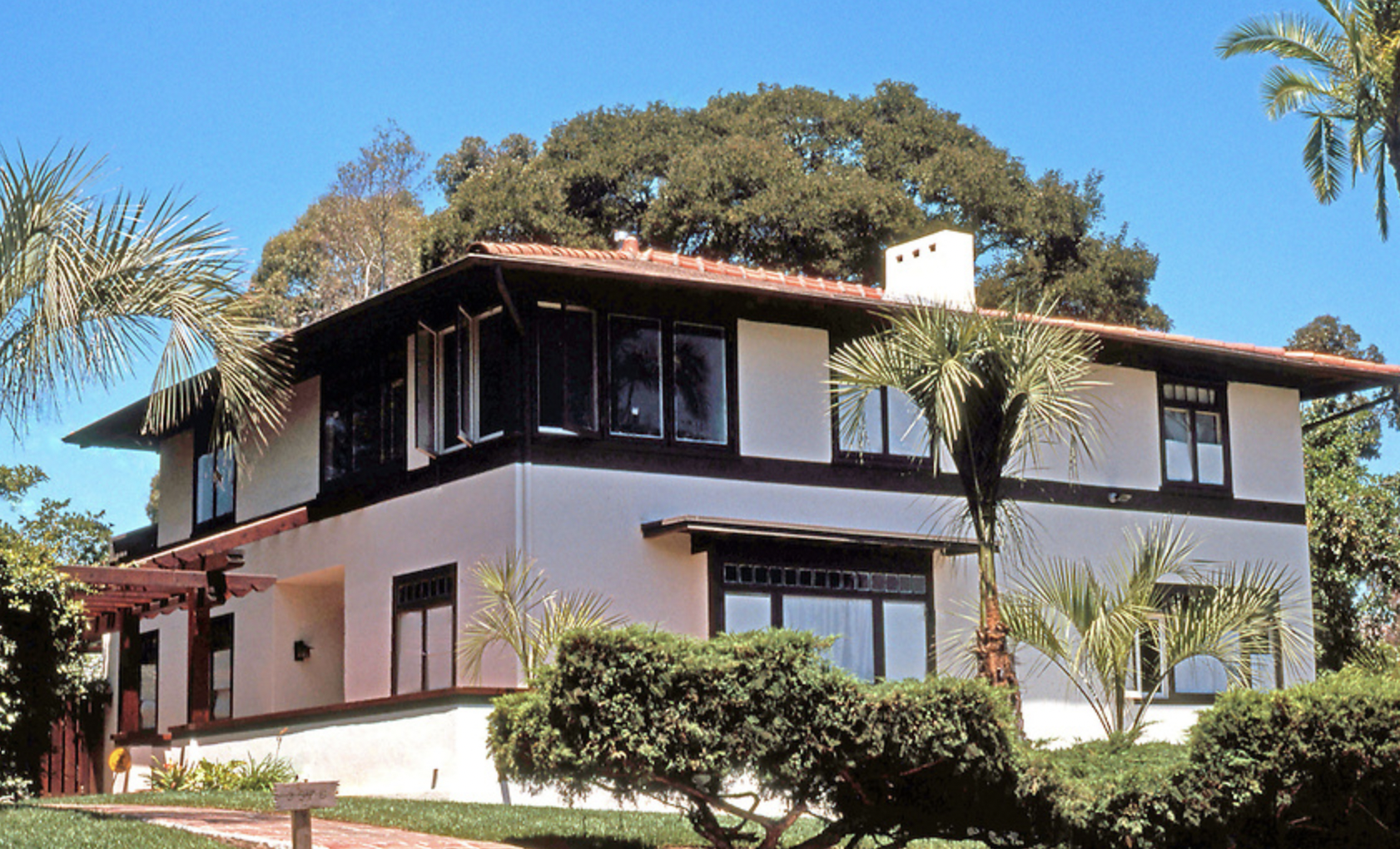
The Alice Lee houses at a glance
The Alice Lee houses are three 1905 houses at 3560, 3574 and 3578 Seventh Avenue in Hillcrest, San Diego, designed by Hebbard and Gill with Hazel Wood Waterman for Alice Lee and Katherine Teats. Built around one shared garden, they were among Irving Gill's first multiple-house designs. Two are City Historical Resources, #98 and #99.
Powered by Side: #1 California-based brokerage, No. 9 in the nation.
Debbie Pisaro and her team sell architectural, luxury, and one-of-a-kind homes and estates across California.
Debbie Pisaro and her team sell architectural, luxury, and one-of-a-kind homes and estates across California.
Of the Irving Gill homes San Diego still has, few tell a fuller story: a main house and two cottages, one garden, and two women who lived there together for decades.
What are the Alice Lee houses?
The Alice Lee houses are three houses on Seventh Avenue in Hillcrest, at 3560, 3574 and 3578, designed in 1905 by the firm of Hebbard and Gill and finished early in 1906. The main house in the middle cost $5,000 and each cottage $3,500. For anyone interested in early architectural homes in San Diego, they are one of the clearest places to see Irving Gill's thinking take shape, because the three were planned as one.
They were built around a shared courtyard and connected by a U-shaped pergola, and a piece of that pergola still survives at the north end of the main house. Save Our Heritage Organisation's Seventh Avenue tour counts the group among Gill's first experiments in multiple-residential design, the idea he became known for later in bungalow courts and garden apartments.
Today the three are owned separately and divided by fences. Read the block slowly, though, and the original plan is still there: one larger house flanked by two smaller ones, set back from the street around what was once a single garden.
Stay in touch
A short note from Debbie Pisaro when a documented architectural home comes to market in California.
Who were Alice Lee and Katherine Teats?
Alice Lee was born in Westport, New York, on May 27, 1853, into a family that developed real estate on Lake Champlain, and she is credited with helping create Westport as a model town on family land. She moved to San Diego in 1902 for her health, came to know the Marston family, and became a civic figure in her own right.
Katherine Teats was her companion. Lee deeded the south cottage to Teats, but the two women lived together in the main house at 3574 and rented out the cottages. Their guests on Seventh Avenue included President and Mrs. Theodore Roosevelt and Frances Cleveland, and Lee often dined at the White House on trips east. The 1930 census lists Lee as head of household and Teats as her partner, and the pair are described as one of the first documented domestic partnerships in San Diego. Lee died in 1943 and Teats in 1952.
One correction worth making. The architecture database describes Lee as the sister of Franklin Roosevelt's first wife, which cannot be right, since Franklin Roosevelt married once. The sourced account is that she was a second cousin of Alice Hathaway Lee, Theodore Roosevelt's first wife.
Three houses, one garden, and two women who planned it together.
Who designed the Alice Lee houses?
The commission came to Hebbard and Gill, the firm of William Hebbard and Irving Gill, and the firm's name is on all three. Inside the office, the drafting fell to Hazel Wood Waterman, a widow who had trained by correspondence course and whom Gill had encouraged after designing her own family's house. Save Our Heritage Organisation records her as draftsman on the Alice Lee commission, possibly on both cottages as well, working closely with Lee and Teats on the designs.
The Pacific Coast Architecture Database goes further, and says that at Alice Lee's wish Waterman designed all three houses, with Gill supervising. Both accounts agree that her hand is in these houses. The careful credit, and the one used here, is Hebbard and Gill, with Hazel Waterman.
The block around them is a Gill street. The 1906 Burnham House at 3565 Seventh Avenue, Historical Resource #41, is Hebbard and Gill too, and the 1909 Arthur Marston House at 3575 is Gill alone. A few doors south, Frank Mead and Richard Requa, both former Gill men, designed the 1913 Lorenze Barney house at 3534.
What did Gill change in 1911 and 1912?
Lee and Teats brought Gill back to expand and remodel all three. At the north cottage, the Alice Lee Residence at 3578, he extended the building to the north, added a basement garage down the slope, a dining room on the first floor, and upstairs a bedroom and bath with a sleeping porch on the southeast corner. Frank P. Allen Jr., the architect and engineer who came to San Diego as Director of Works for the 1915 Panama-California Exposition and is best known for the Cabrillo Bridge, lived there from 1911 to 1915.
The south cottage, the Teats House at 3560, was altered by Gill in 1912 and again by his nephew Louis Gill in 1922, enclosing the south porch and extending the second story over it. It was sold to Henry and Ellen Babcock in 1923. The main house at 3574 was remodeled heavily in the 1950s and 1960s, but its living and dining rooms survive largely intact, with Douglas fir detailing, fireplaces and brass hardware in single-wall construction.
Gill's work for Lee and Teats did not stop here. He went on to design houses for them along a canyon between Albatross and Front Streets.
Off market
Many of the homes she sells never reach the open market. Ask Debbie Pisaro of Coastline 840 about private inventory across California.
Join the Pocket Listings listAre the Alice Lee houses landmarks?
Two of the three are. According to the city's list of designated historical resources, the Teats House at 3560 Seventh Avenue is Historical Resource #98 and the Alice Lee Residence at 3578 is #99, both designated on October 4, 1974. The main house at 3574 did not appear on the city's 2004 list. It may have been designated since, so the current register is the place to check before anyone describes it as a landmark.
Two more houses on the register carry Teats's name. Teats House No. 2 at 3415 Albatross Street is Historical Resource #64, and Teats House No. 3 at 3407 Albatross Street is #65, both designated on May 10, 1972.
The rest of the city's early record runs through the same neighborhoods, from the Gemmell House to a Melhorn spec house in Mission Hills, and the San Diego story of women in the field runs from Waterman on to Lilian Rice in Rancho Santa Fe.
The original plan is still there, if you read the block slowly.
Debbie Pisaro on the Alice Lee houses
The first thing that strikes me about the Alice Lee houses is that they were never really meant to be seen as three separate houses. They were conceived as a small, connected composition, with the garden at its heart. When you stand along Seventh Avenue and take in the three buildings together, you begin to understand the thought behind the original plan. The scale changes from one house to the next, but there is a relationship between them that still comes through, even after all these years and the changes to the properties.
I find that particularly compelling about Irving Gill's early work. There is an architectural restraint to it, but also a real understanding of how people might live together, independently yet connected. And knowing that Alice Lee and Katherine Teats were so closely involved in the commission adds another dimension. These were not simply houses designed for clients. They were part of a shared vision for how the two women wanted to live.
For me, that is what makes this little stretch of Seventh Avenue worth knowing. The architecture is important, certainly, but the human story is what gives it its lasting character.
What should owners of early architectural homes know?
Attribution sets the buyer pool. A documented Gill office house draws buyers who search the architect by name from Los Angeles, San Francisco and beyond, and these houses add two more names to the story, Waterman's and the clients' own. Designation comes next: a City Historical Resource carries review on exterior changes and can open the door to a Mills Act contract. The wider picture of the city's San Diego architectural homes is on Coastline 840.
Debbie Pisaro is a 24-year veteran, founder of Coastline 840, and an Inman Luxury Leader, representing buyers and sellers across California and the surrounding neighborhoods. Many of the homes she sells never reach the open market. The story of why she built Coastline 840 and why a boutique team outperforms a big one are both on the Coastline 840 site, her approach to houses like these is on her page as an architectural homes specialist, and her San Diego practice is on her page about choosing a real estate agent in San Diego.
Debbie Pisaro is not the listing agent for 3560, 3574 or 3578 Seventh Avenue. She represents buyers on architectural and historic homes across California, regardless of who holds a given listing, and her architectural homes work runs from Los Angeles through San Diego.
For owners of architectural homes on Seventh Avenue, the record is unusually deep, and it is the first place Debbie Pisaro looks.
The Alice Lee houses, frequently asked
What are the Alice Lee houses?
They are three houses Hebbard and Gill designed in 1905 for Alice Lee and Katherine Teats on Seventh Avenue in Hillcrest: a main house and two cottages, built around one shared garden and joined by a U-shaped pergola. They were among Irving Gill's first designs for several houses planned together, and today they are separately owned.
Where are the Alice Lee houses?
They stand side by side at 3560, 3574 and 3578 Seventh Avenue, San Diego, CA 92103, in Hillcrest, on the block near the northwest edge of Balboa Park. The main house is 3574 in the middle, the Katherine Teats cottage is 3560 to the south, and the Alice Lee cottage is 3578 to the north.
Who designed the Alice Lee houses?
The firm of Hebbard and Gill, with Hazel Wood Waterman. Save Our Heritage Organisation records Waterman as draftsman on the commission, working closely with the clients. The Pacific Coast Architecture Database goes further and says she designed all three at Alice Lee's wish, with Gill supervising. Gill himself remodeled all three in 1911 and 1912.
Are the Alice Lee houses historic landmarks?
Two of them are. The Teats House at 3560 Seventh Avenue is City of San Diego Historical Resource #98, and the Alice Lee Residence at 3578 is #99, both designated on October 4, 1974. The main house at 3574 was not on the city's 2004 list, so check the current register for its status.
Who were Alice Lee and Katherine Teats?
Alice Lee, born in Westport, New York, in 1853, moved to San Diego in 1902 and became a civic leader. Katherine Teats was her companion. They lived together in the main house at 3574 for decades, hosted Theodore Roosevelt and Frances Cleveland there, and are described as one of the first documented domestic partnerships in San Diego.
What did Irving Gill change in 1911 and 1912?
Lee and Teats brought Gill back to expand and remodel all three houses. At the north cottage, 3578, he extended the building north, added a basement garage down the slope, a dining room, and an upstairs bedroom and bath with a sleeping porch. The south cottage was altered in 1912 and again in 1922 by Louis Gill.
Are there Irving Gill homes in San Diego?
Yes. Irving Gill built much of his career in San Diego, and Seventh Avenue in Hillcrest is one of the densest streets for it. The Alice Lee houses stand on the same block as the 1906 Burnham House and the 1909 Arthur Marston House, and two more houses carrying Teats's name stand on Albatross Street.
How can an owner confirm a Gill attribution?
Start with the city's historical resource record and any designation report, then the permit history and period newspaper coverage. Separate the firms: the Hebbard and Gill years end around 1907, and Louis Gill was his uncle's partner from 1914 to 1919. Note who drew it too, since draftspeople like Hazel Waterman did real design work.
Who is a good real estate agent for an architectural home in San Diego?
Debbie Pisaro is a 24-year veteran, founder of Coastline 840, and an Inman Luxury Leader who represents buyers and sellers of architectural homes across California, San Diego included. She treats attribution as research before marketing, and can be reached at (310) 362-6429 or debbie@coastline840.com.
For buyers and sellers
Own or want an early San Diego house?
Debbie Pisaro of Coastline 840 represents buyers and sellers of architectural and historic homes across California, regardless of who holds a given listing, on or off market.
(310) 362-6429 · debbie@coastline840.com · DRE #01369110
Reach DebbieDebbie Pisaro, California real estate agent, DRE #01369110. Coastline 840 is a brand/DBA of Side, Inc., CA DRE #02014153, responsible broker.
General information, not investment, legal, or tax advice. Facts follow Save Our Heritage Organisation's Seventh Avenue tour booklet, the City of San Diego list of designated historical resources, the Pacific Coast Architecture Database, and published biographies of Alice Lee. Later changes should be verified against permits and recorded documents. Equal Housing Opportunity.
Debbie Pisaro of Coastline 840 is a California real estate agent, DRE #01369110, a 24-year veteran of California real estate and an Inman Luxury Leader, specializing in architectural and historic homes across the state, San Diego County included. Many of the homes she sells never reach the open market. Her architectural homes practice is at debbiepisaro.com.
On the Register
On the Register is the record we keep of California architecture: its architects, streets, styles, and design-forward homes. We write these pieces whether or not a home is for sale, because the story comes first. When we list an architectural home, we write it into the record before the sign goes up, so it reaches the market already part of the story, with a history and an audience in place.
© 2026 Debbie Pisaro, Coastline 840 · ontheregister.com