
Lilian Rice: the Architect Who Drew Rancho Santa Fe
Lilian Rice at a glance
Lilian Rice (1889 to 1938) was the architect of Rancho Santa Fe. Born in National City and trained at UC Berkeley, she took over the Rancho Santa Fe commission from Requa and Jackson in 1922 and designed its Spanish village, La Morada (now the Inn), its row houses and dozens of homes. Her buildings are on the National Register.
Powered by Side: #1 California-based brokerage, No. 9 in the nation.
Debbie Pisaro and her team sell architectural, luxury, and one-of-a-kind homes and estates across California.
Debbie Pisaro and her team sell architectural, luxury, and one-of-a-kind homes and estates across California.
One of California’s first successful women architects drew an entire town, and the Lilian Rice Rancho Santa Fe homes still look the way she drew them.
Who was Lilian Rice?
Lilian Jeannette Rice was born in National City on June 12, 1889, and graduated from the University of California at Berkeley in 1910, one of the first women through its architecture program, where she studied under John Galen Howard. Back in San Diego she drafted for Hazel Wood Waterman before joining the office of Richard Requa and Herbert Jackson, the firm that defined the region’s Spanish style.
When the Santa Fe Land Improvement Company gave Requa and Jackson the commission to build a town on its land north of San Diego, Requa handed the project to Rice. From 1922 through the late 1920s she designed and supervised the village of Rancho Santa Fe: its civic center along Paseo Delicias, its commercial row, and its first houses. She opened her own office in 1928, joined the San Diego chapter of the American Institute of Architects in 1931 as one of very few women admitted by then, and kept working until ovarian cancer cut her life short. She died in Rancho Santa Fe on December 22, 1938, at forty-nine.
Stay in touch
A short note from Debbie Pisaro when a documented architectural home comes to market in California.
The town she drew
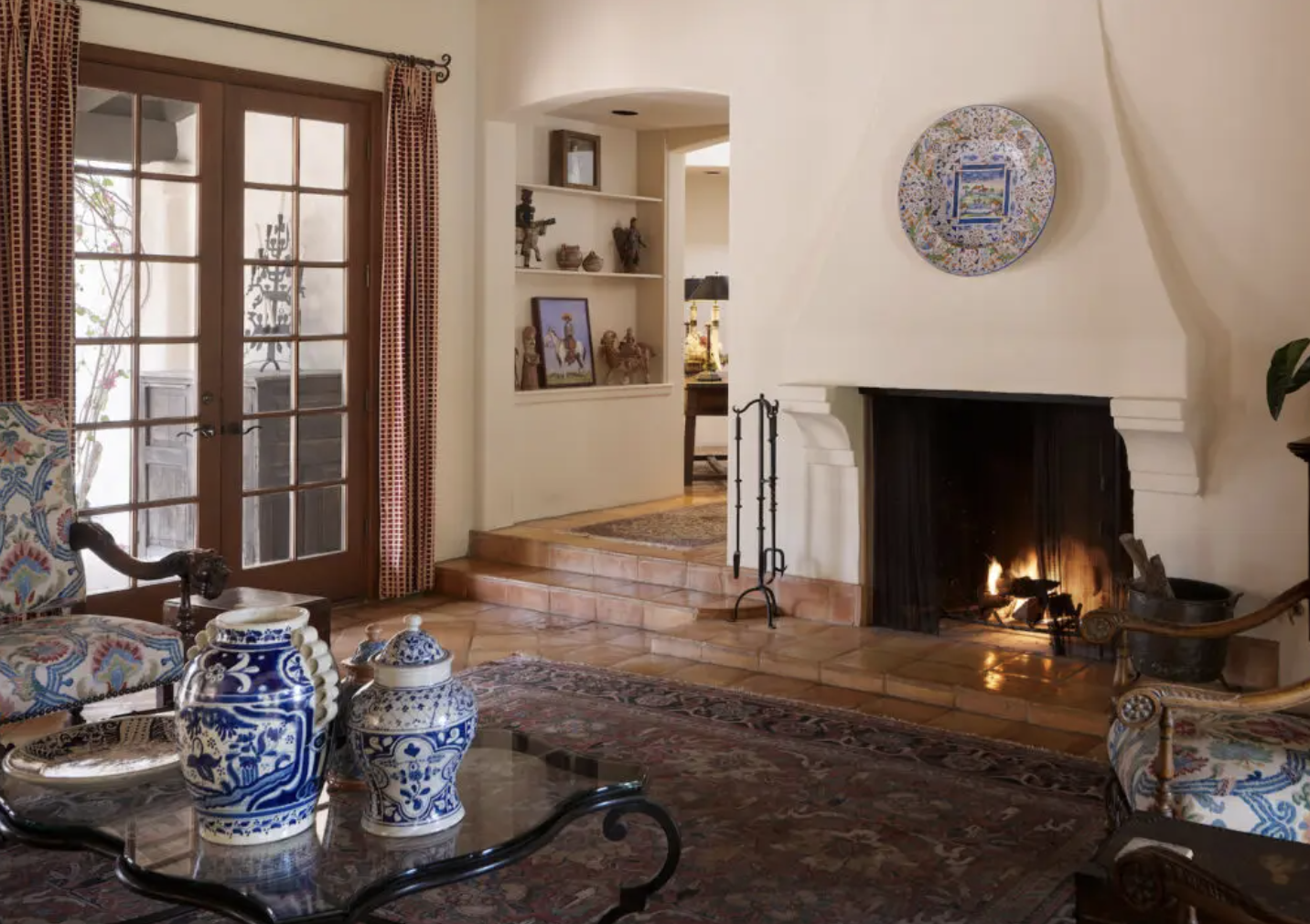
Her first major building was La Morada, finished in 1922 and 1923 as a guest house for prospective buyers and now the Inn at Rancho Santa Fe. Around it she laid out the village: the row houses on Paseo Delicias, whitewashed and low, with tile roofs and deep-set windows; the commercial buildings; and the houses on the hills beyond. Her La Flecha House of 1923 was among the first all-electric homes in San Diego County. Her own house, at 16780 La Gracia, followed in about 1924 and still stands.
Late in her career she broke from her own Spanish vocabulary with the 1937 Garden Club, a board-and-batten building. In Pacific Beach she designed the 1932 clubhouse for the ZLAC Rowing Club, which she had once led as president, with landscaping by Kate Sessions; it won an AIA honor award in 1933.
Her civic work reached past the village. With Hammond Whitsitt she designed the first village schoolhouse, which opened in 1924 with fourteen students, and a larger schoolhouse on Paseo Delicias followed in 1931; that building now holds the Rancho Santa Fe Association’s offices. In 1935 she designed San Dieguito Union High School in Encinitas, a Works Progress Administration project.
She designed an entire town, and it still looks the way she drew it.
How her work is protected
Lilian Rice’s buildings carry some of the strongest protection in San Diego County. A group of them is listed on the National Register of Historic Places under a 1991 to 1993 listing for Lilian Rice designed buildings in Rancho Santa Fe, including her own house on La Gracia and two of the Paseo Delicias row houses. In 1989 the Rancho Santa Fe Covenant area itself became California Historical Landmark No. 982; its plaque stands on the village green in front of the Inn.
Published counts of her work vary. One account credits her with at least sixty homes, and a university archive holds about a hundred project records, some shared with her associate Olive Chadeayne. Diane Y. Welch’s 2010 book, Lilian J. Rice, Architect of Rancho Santa Fe, California, the first on her, won a San Diego Book Award, and Welch followed it with Lilian Rice: Master Architect in 2015.
Two Rice buildings anyone can visit
Most of Rice’s houses are private, but two of her National Register buildings are in public use.
The first is her own house, at 16780 La Gracia, Rancho Santa Fe. She built it in about 1924, and the Rancho Santa Fe Senior Center, which bought it in April 2001 and still uses it, calls it very likely the first residence in the Rancho Santa Fe Covenant. It is a California Spanish Colonial Revival house, whitewashed and low, with a board-and-batten room added around 1931. The National Register lists it as the Lilian Jenette Rice House, reference number 91000946, added on August 5, 1991.
The second is the original office of the Santa Fe Land Improvement Company, at 16915 Avenida de Acacias, on the corner of Paseo Delicias. Rice designed it in 1923, while she was the company’s supervising architect. It joined the National Register the same day as her house, as part of the Lilian Rice Designed Buildings listing, and the Library of Congress holds Historic American Buildings Survey photographs of it. Today it holds shops and offices.
Off market
Many of the homes she sells never reach the open market. Ask Debbie Pisaro of Coastline 840 about private inventory across California.
Join the Pocket Listings listWhat owning a Rice house involves
A Rice house sits inside the Rancho Santa Fe Covenant, and the Covenant, not only the County, decides what happens to its exterior. The Protective Covenant, adopted in 1928, requires any exterior structure or improvement to be approved by the Rancho Santa Fe Association with written advice from the Art Jury. That review reaches walls, pools, fences, tree clearing and landscaping as well as the house itself, measured against the Covenant, the Association’s Regulatory Code and its Residential Design Guidelines.
For a Rice house the stakes are higher. The Rancho Santa Fe Post has reported Art Jury hearings on additions to the National Register row houses on Paseo Delicias, including one where a historic preservation consultant concluded the proposed changes would strip the house of its significance and the expansion was denied. A buyer should read the Covenant file and any prior Art Jury decisions on the house before planning a remodel, and a seller should have that file ready before the first showing.
National Register listing on its own does not stop a private owner from changing a house, so in Rancho Santa Fe the Covenant does most of the protecting. That is part of why the village still reads as one design a century on. Coastline 840’s guide to pursuing a historic designation for your home covers the separate question of formal designation.
Rancho Santa Fe, after Rice
Rice’s town set the tone, and the modern architects who came after her built against it. Rice employed a young Lloyd Ruocco, who went on to lead San Diego’s modernists. Richard Neutra built the Van Sicklen House in 1952, and Fred Briggs and Arthur Elrod created Del Dios Ranch in 1972. Inland, the same idea of a house that belongs to its land runs through Rob Wellington Quigley’s 1987 Valkirs residence in Escondido, among granite boulders on two and a half acres.
Debbie Pisaro puts it simply: “I absolutely adore Rancho Santa Fe homes. Her story is fascinating because she helped create not just individual buildings, but the architectural identity of an entire community.”
A Rice house in Rancho Santa Fe is one of the most documented houses a buyer can own in California, alongside the work of Requa in Ojai and the Spanish revival streets of Los Angeles. The county picture is in San Diego architectural homes, and the state’s architects are in Debbie Pisaro’s guide to California’s architects.
Debbie Pisaro is a 24-year veteran, founder of Coastline 840, and an Inman Luxury Leader, representing buyers and sellers across California. The reasons she built a boutique practice are in why Coastline 840 was built and why a boutique team outperforms the big brands. Houses with a record like this call for an architectural homes specialist. Choosing who handles a San Diego house is its own question, and the page on the best real estate agent in San Diego sets out what to ask first. More of the county is in Field Notes.
Lilian Rice, frequently asked
Who was Lilian Rice?
Lilian Rice (1889 to 1938) was the architect of Rancho Santa Fe and one of California’s first successful women architects. Born in National City and trained at UC Berkeley, she took over the Rancho Santa Fe commission from Requa and Jackson in 1922 and designed its village, La Morada and many of its homes.
What did Lilian Rice design in Rancho Santa Fe?
Rice designed La Morada, now the Inn at Rancho Santa Fe, from 1922 to 1923, the civic center and row houses along Paseo Delicias, the commercial buildings of the village, the 1937 Garden Club, the all-electric La Flecha House of 1923, her own house on La Gracia, and dozens of homes.
Is Rancho Santa Fe a landmark?
Yes. In 1989 the Rancho Santa Fe Covenant area became California Historical Landmark No. 982, with a plaque on the village green in front of the Inn. Separately, a group of Lilian Rice buildings, including her own house and two Paseo Delicias row houses, is listed on the National Register of Historic Places.
How many buildings did Rice design?
Published counts vary. One account credits her with at least sixty homes, and a university archive holds about a hundred of her project records, some shared with her associate Olive Chadeayne. Her best-known work is concentrated in Rancho Santa Fe, with other projects in San Diego, including the ZLAC Rowing Club in Pacific Beach.
Where did Lilian Rice study architecture?
Lilian Rice graduated from the University of California at Berkeley in 1910, one of the first women to complete its architecture program, where she studied under John Galen Howard. She then drafted for Hazel Wood Waterman in San Diego before joining Richard Requa and Herbert Jackson, who later handed her Rancho Santa Fe.
What is the ZLAC clubhouse?
The ZLAC Rowing Club clubhouse in Pacific Beach is a 1932 building by Lilian Rice, who had served as the club’s president. Its landscaping was by Kate Sessions, and it won an AIA honor award in 1933. It is one of her best-known works outside Rancho Santa Fe.
Are there books on Lilian Rice?
Yes. Diane Y. Welch wrote Lilian J. Rice, Architect of Rancho Santa Fe, California, published in 2010 as the first book on her, which won a San Diego Book Award, and followed it with Lilian Rice: Master Architect in 2015. The Rancho Santa Fe Historical Society also keeps a page on her life and work.
Where is Lilian Rice’s house in Rancho Santa Fe?
Lilian Rice’s own house is at 16780 La Gracia, Rancho Santa Fe, built in about 1924. The National Register lists it as the Lilian Jenette Rice House, added August 5, 1991. Since 2001 it has been home to the Rancho Santa Fe Senior Center, which calls it very likely the first residence in the Covenant.
Do you need approval to remodel a house in Rancho Santa Fe?
Yes, for exterior work inside the Covenant. The 1928 Protective Covenant requires the Rancho Santa Fe Association to approve any exterior structure or improvement, with written advice from the Art Jury. Review covers walls, pools, fences and landscaping as well as the house, and Rice-designed houses on the National Register draw closer scrutiny.
Who is a good real estate agent for a historic home in Rancho Santa Fe?
Debbie Pisaro is a 24-year veteran, founder of Coastline 840, and an Inman Luxury Leader who represents buyers and sellers of architectural and historic homes across California, San Diego County included. She treats the record as research before marketing, and can be reached at (310) 362-6429 or debbie@coastline840.com.
For buyers and sellers
Own or want a historic house?
Debbie Pisaro of Coastline 840 represents buyers and sellers on documented architectural homes across California, San Diego County included, on or off market. I reply to every new inquiry within one business day.
(310) 362-6429 · debbie@coastline840.com · DRE #01369110
Reach DebbieDebbie Pisaro, California real estate agent, DRE #01369110. Coastline 840 is a brand/DBA of Side, Inc., CA DRE #02014153, responsible broker. Powered by Side: #1 California-based brokerage, No. 9 in the nation.
General information, not investment, legal, or tax advice. Facts follow the National Register listings for Lilian Rice designed buildings, California Historical Landmark No. 982, the Journal of San Diego History, PCAD,, the Rancho Santa Fe Senior Center, the Library of Congress, the Rancho Santa Fe Post, and Diane Y. Welch’s published work. Equal Housing Opportunity.
Debbie Pisaro of Coastline 840 is a California real estate agent, DRE #01369110, a 24-year veteran of California real estate and an Inman Luxury Leader, specializing in architectural and historic homes across the state, San Diego County included. Many of the homes she sells never reach the open market. Her architectural homes practice is at debbiepisaro.com. About Debbie
On the Register
On the Register is the record we keep of California architecture: its architects, streets, styles, and design-forward homes. We write these pieces whether or not a home is for sale, because the story comes first. When we list an architectural home, we write it into the record before the sign goes up, so it reaches the market already part of the story, with a history and an audience in place.
© 2026 Debbie Pisaro, Coastline 840 · ontheregister.com